Grey floors had a good run. But if you’ve walked into a new build or a renovated home this year, you’ve probably noticed something warmer underfoot.
Hardwood flooring trends for 2026 are moving away from cool, ashy tones and heading straight into honey, caramel and soft walnut territory. It’s not a small shift either. Showrooms, builders and designers across Calgary are all pointing the same direction.
At Arbutus Hardwood, we’ve spent over 30 years installing, refinishing and repairing floors across Calgary. We’re seeing this shift play out in real homes, not just in showroom displays. Here’s what’s actually trending in 2026 and what it means once you factor in Calgary’s climate.
Hardwood flooring trends 2026 at a glance
Trend
What’s driving it
Best for
Warm wood tones
Move away from cold, sterile interiors
Living rooms, main floors
Wide plank flooring
Fewer seams, open-concept flow
Open-concept new builds
Matte and low-sheen finishes
Practicality, easier maintenance
Households with kids or pets
Wire-brushed and textured surfaces
Authenticity, hides daily wear
High-traffic areas
Herringbone and chevron patterns
Craftsmanship without a full redesign
Entryways, dining rooms
Engineered hardwood
Climate stability, radiant heat compatibility
Basements, Calgary homes generally
Sustainable and low-VOC materials
Health and long-term value
Whole-home renovations
Each one of these shows up across nearly every design report this year, but a few matter more in Calgary specifically than they do somewhere with a milder, more consistent climate. We’ll get into why below.
Warm wood tones are replacing cool grey
For close to a decade, grey ruled. Whitewashed oak, driftwood stains, anything that read cool and neutral.
That era is winding down.
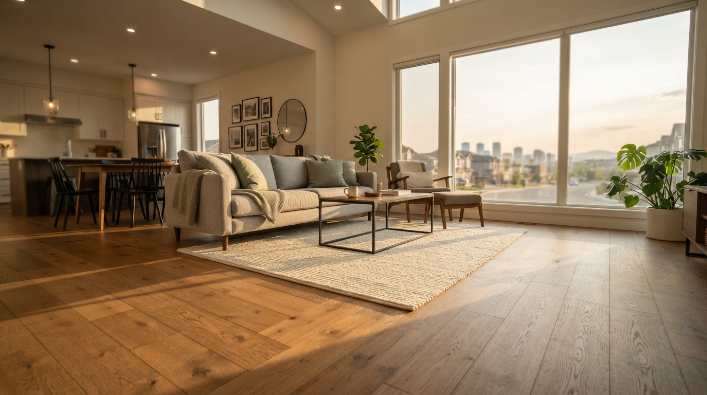
Homeowners in 2026 want honey oak, caramel, rich brown and greige (a soft blend of grey and beige that still leans warm). These tones do something practical too. In a Calgary condo or a smaller main-floor space, warmer wood makes the room feel bigger and brighter, especially during the long stretch of grey winter days we get here.
Warm tones also pair well with sage greens, cream textiles and matte black hardware, which is the look most designers are pushing right now.
If you’re weighing species rather than just color, it helps to know how each one takes a stain. Our breakdown ofred oak vs white oak flooring covers how the two hold color differently over time, which matters more than most people expect once a floor is a few years old.
One thing we tell clients often: a sample board under showroom lighting almost never matches how a floor looks in your actual home. Calgary gets intense, low-angle sun for a good chunk of the year. That light pulls warm undertones out of wood in a way fluorescent showroom lighting just doesn’t. Bring a sample home and look at it in your own living room before committing to a full order.
Grey isn’t gone completely. Some homeowners doing a modern, minimalist build still ask for it and it still works in the right space. As a default though, it’s lost the position it held for most of the 2010s and early 2020s.
Wide plank flooring keeps growing
Standard 3-inch planks aren’t disappearing completely, but 7-inch to 10-inch wide planks are now the go-to for anyone doing a full main-floor renovation.
Wider boards mean fewer seams. Fewer seams mean a cleaner, more open look, especially in the kind of open-concept living and dining spaces common in newer Calgary builds.
There’s a tradeoff worth knowing about though. Wide boards move more than narrow ones as humidity shifts through the seasons. Calgary’s dry winters make that movement more noticeable than it would be somewhere humid year-round. The installation method matters a lot here. We walk through the technical side innail-down vs glue-down hardwood floors if you’re deciding between the two for a wide-plank project.
A few of our recent Calgary projects have used what’s sometimes called a “variable width” layout: mixing 5-inch, 7-inch and 9-inch boards in the same room instead of one uniform size. It creates a look closer to older European homes, where boards weren’t perfectly standardized. It’s more work to plan and lay out correctly, but the result reads as custom rather than off-the-shelf, which is exactly the point.
Longer board lengths are part of this trend too, not just width. Fewer end joints across a room means fewer visual breaks and, honestly, fewer weak points over the life of the floor.
Matte finishes have replaced high gloss
Glossy floors used to be the default finish almost everywhere. Not anymore.
Matte and low-sheen finishes are now the preferred option for most homeowners. It’s not purely an aesthetic choice either. Matte surfaces hide dust, scuffs and footprints far better than a glossy topcoat does. For a household with kids, pets or just a lot of daily foot traffic, that’s a real difference in how often you’re cleaning.
The type of finish you pick changes more than just the shine level too. Oil-based finishes tend to darken slightly over time and need more regular maintenance, while water-based finishes stay clearer and cure faster after application. We cover the full tradeoff inoil vs water-based floor finish.
Wire-brushed and hand-scraped textures
Alongside matte finishes, texture is having a moment.
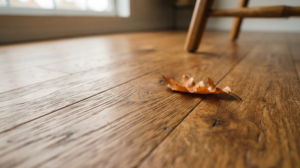
Wire-brushed and hand-scraped surfaces pull out the natural grain of the wood and leave a floor that looks and feels lived-in rather than perfectly smooth. There’s a practical side to this too: texture is genuinely better at hiding minor scratches and everyday wear than a flat, glass-smooth surface.
This trend fits naturally with the warm-tone movement. A honey oak floor with wire-brushed texture reads a lot more authentic than the same color in a flat, polished finish.
Hand-scraped is the more dramatic version of texture, with deeper grooves that mimic the look of an old, hand-finished floor. It’s a stronger design statement than wire-brushing, so it tends to show up more in character-heavy homes, like older Calgary properties in neighborhoods such as Bridgeland or Inglewood, where a bit of history in the flooring fits the rest of the house.
If you’re unsure how much texture is too much, start small. A wire-brushed floor in a main living area, kept subtle, ages a lot better over a decade than a heavily hand-scraped floor might in a smaller, more modern space.
Herringbone and chevron patterns are making a comeback
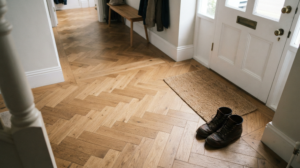
Straight-lay planks still dominate main living areas, but patterned floors are showing up more in entryways, home offices and formal dining rooms.
Herringbone and chevron are the two patterns getting the most attention in 2026. Both add a sense of craftsmanship to a space without requiring a full room redesign around them, which is part of why they’re popular in older Calgary homes going through partial renovations.
Patterned floors take more planning than a standard install though. Board angle, subfloor prep and layout all need to line up before a single piece goes down. Get the layout wrong at the start and the pattern drifts visibly by the time you reach the far wall, which is a hard mistake to fix after the fact.
Chevron tends to read as slightly more formal than herringbone, since the boards meet at a continuous angle rather than a zigzag. Herringbone is more forgiving for irregular room shapes, which is one reason it shows up more often in older Calgary homes with less-than-perfectly-square rooms.
Ourcustom hardwood flooring service handles that planning stage for homeowners who want a pattern floor done right the first time, from the initial layout drawing through the final board.
Engineered hardwood is winning in Calgary specifically
This trend is climate-driven and it’s a big deal for Calgary homeowners specifically.
Solid hardwood expands and contracts with humidity. Calgary’s dry winters and the occasional summer humidity spike put real stress on solid wood floors over the years, sometimes leading to gaps or cupping if the floor wasn’t acclimated properly before install.
Engineered hardwood handles that stress better. Its layered construction resists movement, which makes it a stronger choice for basements, homes with radiant heating and anywhere subfloor conditions aren’t perfectly consistent.
TheNational Wood Flooring Association has tracked this shift at the industry level too, noting that pre-finished engineered products are projected to lead growth this year because of how well they perform across different subfloor types and heating systems.
If you’re trying to decide between the two for your own home, our full comparison ofsolid vs engineered hardwood in Calgary breaks down the cost, lifespan and performance differences side by side.
A lot of contractors who aren’t local to Calgary miss this distinction entirely. They install the same way they would in Vancouver or Toronto, without adjusting for how much drier and more variable our winters are. That’s usually where you see gaps between boards show up a year or two after installation, sometimes even cupping if moisture got trapped before the floor fully acclimated. It’s less about the wood being low quality and more about the install not accounting for local conditions.
Engineered hardwood also opens up rooms that solid wood historically couldn’t handle well, particularly basements. Below-grade concrete slabs hold more moisture than a wood subfloor upstairs and solid hardwood reacts to that directly. Engineered products are built to handle it instead.
Sustainable choices are becoming standard, not optional
FSC-certified hardwood and low-VOC, water-based finishes have gone from a niche request to something most homeowners ask about upfront.
Part of that is health-driven. Low-VOC finishes mean less off-gassing in your home during and after installation, which matters more to people now than it did five years ago. Part of it is just a broader shift toward materials that hold up over decades instead of needing replacement every 10 to 15 years.
Cork flooring is picking up interest too, mostly in basements and home offices where a softer, naturally antimicrobial surface makes sense. It’s not a hardwood replacement everywhere, but it’s worth knowing about if you’re planning a lower-level renovation alongside your main floor.
What’s fading out in 2026
Trends work in both directions. A few flooring choices that dominated the last decade are losing ground this year.
High-gloss finishes. Once the default in new builds, glossy floors now read as dated and show every mark within weeks.
Cold, ashy grey tones. Still around, but no longer the safe default choice it was five years ago.
Very dark, almost black stains. They look striking in photos but show dust and pet hair constantly, which is a hard sell for busy households.
Overly uniform, machine-perfect surfaces. Homeowners are choosing character and natural variation over a flawless, showroom-smooth look.
Thin wear-layer engineered products. As engineered hardwood becomes more popular, buyers are getting pickier about wear layer thickness, since a thin layer limits how many times a floor can be refinished.
None of this means these options are unusable. A dark stain still works beautifully in a large, bright space with the right lighting. It just means they’re no longer the automatic first choice they used to be.
Trendy floors fade. Well-installed floors don’t
Here’s the thing about flooring trends: they’re useful for direction, but they shouldn’t be the only thing driving your decision.
A floor that’s installed properly, acclimated correctly and maintained over time will outlast whatever’s fashionable this year. Hardwood can be sanded and refinished multiple times over its lifespan, sometimes 3 or 4 times for solid wood, which means the floor you choose today doesn’t have to be the floor you’re stuck with in 15 years.
If your current floor is more worn than trendy right now, replacement isn’t always the answer. Ourhardwood floor refinishing service can often bring an older floor back to life at a fraction of what a full replacement would cost. It also lets you update the finish or sheen level to match current trends without tearing anything out.
Bringing these trends into a Calgary home
Every one of these hardwood flooring trends looks great in a photo. Getting them to actually perform well in a Calgary home is a different question. It comes down to installation more than anything else.
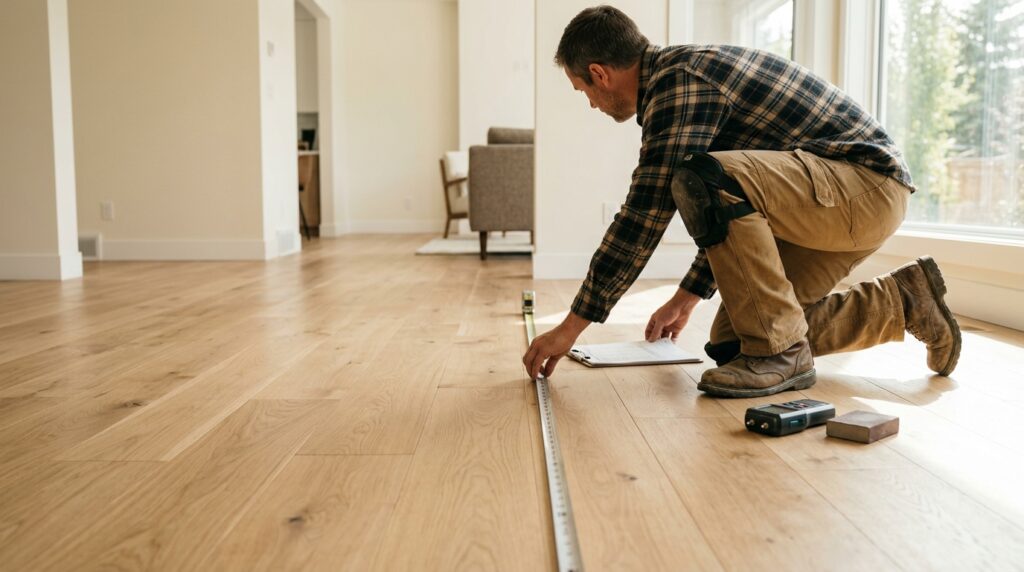
Dry winters shrink improperly acclimated wood. Skipped subfloor prep shows up as squeaks and unevenness within a year or two. Contractors unfamiliar with local conditions sometimes miss both.
Ourhardwood floor installation service is built around Calgary’s climate specifically, from acclimation timelines to subfloor moisture checks before a single board is laid.
If you’re still narrowing down products, it also helps to know what’s actually available locally versus what just looks good in an online catalog. Our guide to thebest hardwood flooring brands in Calgary breaks that down by what we’ve installed and stand behind ourselves.
Which trend fits which room
Not every trend belongs in every space. A few guidelines that tend to hold up in real Calgary homes:
Living rooms and main floors: Wide plank, warm-toned engineered hardwood is the safest bet for the space you’ll spend the most time in and show off the most. It handles Calgary’s humidity swings and still delivers the open, seamless look most homeowners want.
Kitchens: Matte or low-sheen finishes matter more here than anywhere else in the house, since spills and daily wear show up fastest in this room. Engineered construction also holds up better near dishwashers and sinks than solid wood does.
Basements: Engineered hardwood is close to a requirement here, not just a preference, given how much more moisture a below-grade slab holds onto compared to a main-floor subfloor.
Entryways and formal dining rooms: This is where herringbone or chevron patterns earn their keep. These are lower-traffic, high-visibility spaces where a patterned floor makes a strong first impression without needing to survive the same daily abuse as a kitchen or mudroom.
Bedrooms: Softer, warmer tones with a matte finish tend to feel calmer underfoot. Bedrooms also see less foot traffic than the rest of the house, which makes this a reasonable place to experiment with a bolder color or texture.
The bottom line
Hardwood flooring trends in 2026 all point toward warmth, texture and materials that perform well under real, everyday conditions, not just under showroom lighting.
Warm tones, wide planks, matte finishes and engineered construction are all pieces of the same shift: homeowners want floors that feel authentic and hold up over time, especially in a climate like Calgary’s where dry winters test every material choice you make.
If you’re planning a renovation and want to know which of these trends actually make sense for your specific home,get in touch with Arbutus Hardwood for a free quote. We’ve been installing, refinishing and repairing floors across Calgary for over 30 years. We can walk you through what’s worth investing in and what’s just noise this year.
How to choose a hardwood flooring contractor in Calgary Learn how to choose a hardwood flooring contractor in Calgary by checking experience, insurance, past projects and written quotes before you hire. Contact Us Your floors will be under your feet for 20 years or more. The person you hire to…
Hardwood Flooring Cost in Calgary: What You’ll Actually Pay Planning your project but unsure about hardwood flooring cost in Calgary? This guide explains installation, refinishing, and repair expenses to help you plan your flooring budget. Contact Us If you’re planning to install, repair, or refinish hardwood flooring in Calgary, understanding…
Matte vs gloss hardwood flooring: which finish is right for your home? Matte vs gloss hardwood flooring, see which finish suits Calgary homes best for durability, style & upkeep. Get expert advice from Arbutus Hardwood. Contact Us Matte vs gloss hardwood flooring feels like a small decision until you’re standing…