Solid vs Engineered Hardwood: Which Is Best for Calgary Homes?
Choosing between solid and engineered hardwood comes down to how well each handles Calgary’s extreme, dry climate. While solid wood offers timeless luxury, engineered hardwood provides superior stability against seasonal gapping and warping. Weighing durability, budget, and long-term performance is key to making the right choice for your home.
If you’re renovating or building in Calgary, you’ve probably hit the same wall every homeowner does: solid hardwood or engineered hardwood? Both look stunning in showroom photos. Both are marketed as “the better choice.” And neither salesperson is going to tell you which one actually holds up once our winters get involved.
That’s the real question behind solid vs engineered hardwood: not which one is objectively superior, but which one survives Calgary’s dry air, sudden Chinook swings, and finished basements without turning into a five-year headache.
We’ve spent years refinishing and repairing floors across Calgary and the surrounding communities, and we’ve seen firsthand what actually happens to each type of flooring once the honeymoon phase ends. This guide breaks it down honestly, including the parts most flooring blogs skip over.
What’s Actually Different Between Solid and Engineered Hardwood?
Before comparing performance, it helps to understand what you’re buying. These aren’t just two grades of the same product. They’re built differently, and that construction is what determines how they behave in your home.
What Is Solid Hardwood Flooring?
Solid hardwood is one piece of wood, top to bottom, usually around ¾ inch thick. Oak, maple, walnut, and hickory are the most common species used in Calgary homes. Because the entire plank is a single piece of timber, it reacts to humidity the same way a tree does: it swells when moist air is around and shrinks when the air dries out.
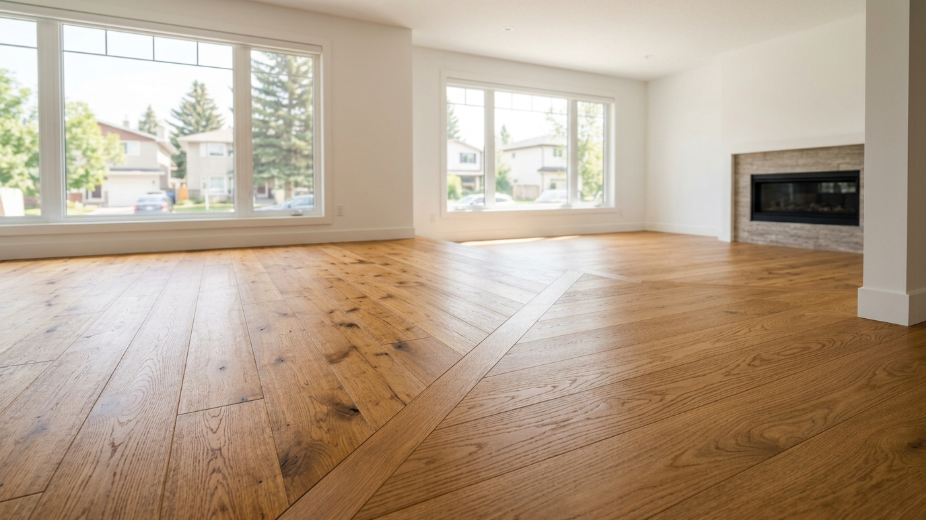
If you’d rather move beyond the standard oak or maple look, wider planks, unique stains, herringbone or chevron patterns, and less common species are all achievable through acustom hardwood flooring project rather than off-the-shelf material.
That’s not a flaw. It’s just wood being wood. The trade-off is that solid hardwood can be sanded and refinished repeatedly over its lifetime, often five to seven times, which is a big part of why it’s still considered a long-term investment rather than a disposable finish.
What Is Engineered Hardwood Flooring?
Engineered hardwood has a real wood veneer on top, bonded to several layers of plywood or high-density fiberboard underneath. Each layer runs in a different direction, which is what makes it more dimensionally stable than solid wood.
This layered structure is why engineered hardwood tends to handle humidity swings better and why it’s the go-to option for basements or floors installed over radiant heating, spaces where solid hardwood typically isn’t recommended.
Why Calgary’s Climate Changes the Answer
This is the part most comparison articles gloss over, and it’s the reason a flooring choice that works fine in Vancouver or Toronto can fail here.
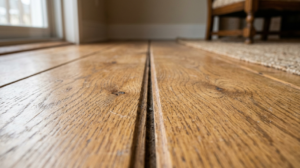
Calgary winters routinely drop indoor relative humidity below 20 percent once central furnace heating kicks in for months on end. Then summer arrives and relative humidity rises. Add rapid Chinook wind events which can swing outdoor temperatures by 15°C to 20°C within a few hours and wood flooring in Alberta is under far more structural stress than in almost any other Canadian market.This is also why gaps between boards are so common here, and you can read more about why gaps appear in Calgary winters and what to do about them.
According toEnvironment Canada’s climate normals data for Calgary,Calgary regularly experiences some of the widest daily temperature swings in the country, largely due to Chinook events. That’s not marketing language. It’s a documented weather pattern, and it’s exactly why local installation and care matter more here than the national average advice you’ll find online.
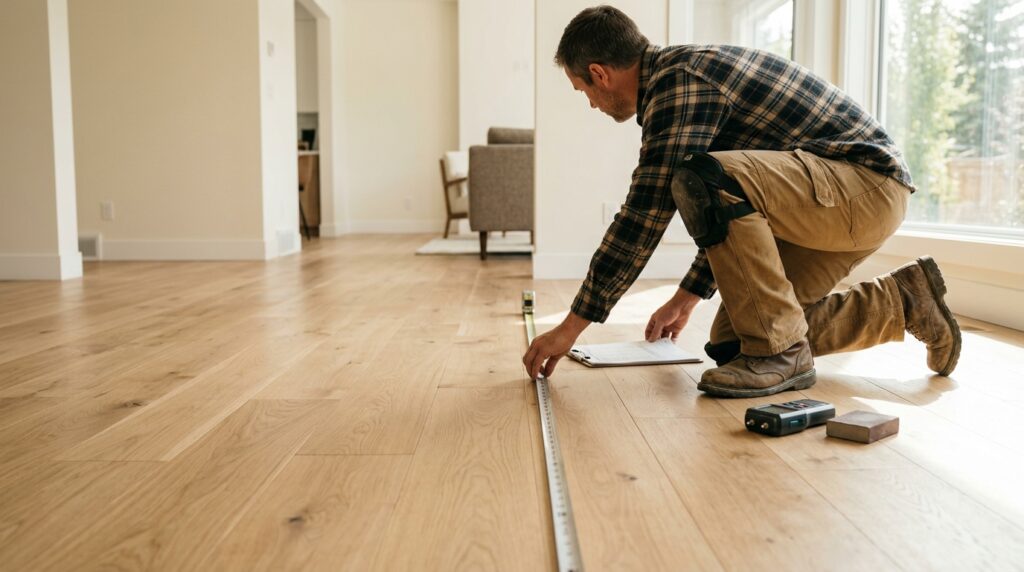
The Critical Acclimation Factor Before a single plank is installed, wood must reach Equilibrium Moisture Content (EMC) inside your home. In Calgary’s dry climate, solid hardwood requires a minimum of 5 to 7 days to acclimate inside a temperature-controlled environment. Engineered hardwood typically needs 48 to 72 hours. Rushing or skipping acclimation in southern Alberta is the single leading cause of winter gapping, board warping, and floor squeaks.
Solid vs Engineered Hardwood: Side-by-Side Comparison
Factor
Solid Hardwood
Engineered Hardwood
Construction
Single piece of wood
Wood veneer over plywood/HDF core
Humidity Stability
Requires humidity control
Naturally more stable
Refinishing
5–7 times over its lifespan
1–2 times, depending on wear layer
Basement Installation
Not recommended
Suitable
Radiant Heat Compatible
Not recommended
Yes
Upfront Cost
Higher
Generally lower
Lifespan (with care)
50–100+ years
25–30 years
Resale Perception
Premium, traditional
Modern, practical
Refinishing and Lifespan: The Difference That Matters Most
Here’s what a lot of homeowners don’t realize until they’re a decade into owning their floors: refinishing potential is the single biggest long-term difference between these two products.
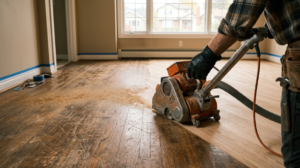
Solid hardwood’s biggest advantage is that it can be sanded down and refinished multiple times over its lifetime—typically 5 to 7 times depending on the depth of the groove. Scratches from pets or moving furniture, worn traffic paths near doorways, or a stain color you no longer like can all be corrected with proper hardwood floor refinishing. We’ve refinished 30-year-old solid oak floors across Calgary and had them come out looking better than the day they were installed.
Engineered hardwood can also be refinished, but only if the top wear layer (lamella) is thick enough.
1mm – 2mm wear layer: Cannot be sanded with a heavy belt sander. It can only be lightly buffed and recoated.
3mm – 4mm wear layer: Can typically be fully sanded and refinished 1 to 2 times.
5mm – 6mm wear layer: Can be refinished 2 to 3 times, performing almost on par with solid wood.
Once you sand past that real wood veneer, you hit the plywood or fiberboard core, causing irreversible damage. If you’re choosing engineered hardwood, always check the exact wear layer thickness on the spec sheet before buying.
Installation Differences You Should Know
Nail-Down vs Glue-Down
Solid hardwood is almost always nail-down or staple-down onto a plywood subfloor. Engineered hardwood is more flexible here. It can be nailed, glued, or even floated depending on the product, which is part of why it works over concrete slabs and radiant heat systems where nailing isn’t an option.
If you’re comparing installation methods for your specific subfloor, our breakdown ofnail-down vs glue-down hardwood floors covers which method suits different room types and why it matters for long-term stability.
Basements, Concrete Slabs, and Radiant Heat
This is a straightforward technical rule: Solid hardwood should never be installed directly over concrete or in below-grade basements. Concrete slabs naturally absorb and transfer moisture from the surrounding soil. Over time, that vapor migrates into solid wood planks, causing cupping, crowning, or severe structural warping.
Engineered hardwood’s criss-cross layered core resists multidirectional movement, making it the industry standard for basement renovations and homes with in-floor radiant heating systems.
However, engineered wood isn’t immune to moisture. Before installing engineered floors over a Calgary basement slab, a proper concrete relative humidity (RH) moisture test must be performed. Even dimensional stability requires a proper moisture barrier underlayment or epoxy sealer to protect your investment long-term.
Engineered Hardwood in Calgary: What to Know Before You Buy
Engineered hardwood is one of the most practical flooring choices for Calgary homes. Its layered core resists the expansion and shrinking caused by our dry winters and Chinook swings, and it can be installed over concrete slabs, in basements and over radiant heat, where solid hardwood isn’t recommended. A real wood veneer on top means you still get the look and feel of hardwood.
Engineered oak typically costs $8 to $13 per square foot installed in Calgary, depending on the product and subfloor. When choosing a product, check the wear layer thickness first: a wear layer of 3 mm or more allows the floor to be refinished at least once. You can source quality engineered flooring through our hardwood flooring supply service.
Finish Options for Both Types
Both solid and engineered hardwood need a protective topcoat, and the finish you choose affects durability just as much as the wood itself. Water-based polyurethane dries fast and stays clear. Oil-based polyurethane gives that warm amber tone but takes longer to cure. Hard wax oils sit into the wood rather than on top, which makes small scratches easier to spot-repair.
If you’re deciding between finish types, our comparison ofoil vs water-based floor finish goes deeper into drying time, smell, durability, and which option holds up best against Calgary’s dry indoor air.
Cost Comparison: Solid vs Engineered Hardwood in Calgary
Cost Factor
Solid Hardwood
Engineered Hardwood
Material Cost (per sq ft)
$6.00 – $14.00
$4.00 – $10.00
Installation Labor (per sq ft)
$4.00 – $8.00
$3.00 – $7.00
Subfloor Prep / Moisture Testing
$1.00 – $2.50 / sq ft
$1.00 – $3.00 / sq ft (Slab prep)
Old Floor Removal & Disposal
$1.50 – $3.00 / sq ft
$1.50 – $3.00 / sq ft
Refinishing Cost (per sq ft)
$4.00 – $7.50
$4.00 – $7.50 (Wear layer dependent)
Expected Lifespan
50 – 100+ Years
25 – 35 Years
Engineered hardwood usually wins on upfront price. But if you’re planning to stay in your home for decades, solid hardwood’s refinishing lifespan often makes it the cheaper option long-term, since you’re not paying for full replacement every 20-25 years.
Pricing also depends heavily on where the material comes from. Working directly with ahardwood flooring supply source instead of a big-box retailer usually means better species selection, accurate stock availability, and pricing that reflects the actual grade of wood you’re getting.
Moisture, Water Damage, and Long-Term Care
Wood and moisture don’t mix well, regardless of which type you choose. Solid hardwood is more vulnerable simply because there’s no protective layered core beneath it. A slow leak under a dishwasher or a forgotten spill near a plant can cause staining, cupping, or even structural damage if it’s not caught early.
Engineered hardwood handles minor moisture exposure better, but it isn’t waterproof. Standing water for extended periods will still damage the veneer and, eventually, the core layers underneath.
If you’ve noticed dark spots, soft areas, or a musty smell near your flooring, don’t wait. Our guide onwater-damaged hardwood repair walks through what can typically be saved and when replacement of a section becomes necessary.
Not every issue needs a full refinish, either. A handful of damaged boards, a squeak, or a dent from dropped furniture is often better solved with targetedhardwood floor repair rather than sanding and refinishing an entire room.
For reference on humidity best practices, theNational Wood Flooring Association’s technical guidelines recommend keeping indoor relative humidity between 30 and 50 percent to protect any hardwood installation, a range that lines up closely with what we recommend to Calgary clients running furnace humidifiers through the winter.
Which One Should You Choose?
There’s no universal right answer here. It genuinely comes down to where the floor is going and how long you plan to keep it.
Choose Solid Hardwood If:
You’re flooring a main or upper level, not a basement
You’re willing to run a humidifier during winter months
You want a floor that can be refinished multiple times over decades
You’re planning to stay in the home long-term or want to preserve resale value
You like the authentic feel and sound of real, single-piece wood underfoot
Choose Engineered Hardwood If:
You’re finishing a basement or installing over radiant heat
You want more built-in stability without babysitting humidity levels
Your budget favors a lower upfront cost
You’re renovating a rental property or a secondary home
You still want the look and feel of real wood, just with less maintenance
Solid vs Engineered Hardwood for Calgary’s Nearby Communities
Flooring decisions don’t change much once you leave city limits, but local conditions can shift slightly depending on the community.
In Airdrie and Chestermere, newer builds often have concrete basements ideal for engineered hardwood, while main floors handle solid hardwood well with proper humidity control. Cochrane homeowners dealing with older character homes often lean toward solid hardwood for refinishing flexibility, especially in heritage properties where matching original wood tones matters.
In Okotoks, we regularly install and refinish both types depending on the home’s age and layout. If you’re in the area, our hardwood floor refinishing in Okotoks service covers exactly this kind of solid-vs-engineered assessment on-site.
Acreage properties around Priddis and Strathmore tend to see more seasonal humidity swings due to their exposure, which is why we often recommend engineered hardwood for lower levels and solid hardwood for main living spaces. If repair work comes up in that area, our hardwood floor repair in Priddis team handles both types.
Wherever you’re located around Calgary, the underlying advice stays the same: match the flooring type to the room’s conditions, not just to personal preference.
Common Mistakes Homeowners Make
Skipping the humidifier during winter: Operating solid hardwood without a furnace humidifier during a Calgary winter leads to unsightly gapping between boards and potential surface checking (cracking).
Rushing the acclimation phase: Installing wood materials straight off the delivery truck without letting them adjust to indoor relative humidity guarantees post-installation movement.
Ignoring wear layer specifications: Buying engineered wood based solely on overall plank thickness rather than the actual top veneer thickness.
Installing solid hardwood over concrete or in basements: Pushing solid wood into below-grade moisture conditions almost always leads to board cupping and failure within a few seasons.
Skipping subfloor moisture testing: Failing to test basement slab emissions before laying engineered flooring over concrete.
Final Thoughts
Both solid and engineered hardwood can perform beautifully in a Calgary home, but only if they’re matched to the right space and maintained with our climate in mind. Solid hardwood rewards homeowners who are willing to manage indoor humidity and want a floor that can be refinished for generations. Engineered hardwood rewards homeowners who need stability in basements, radiant-heated spaces, or budget-conscious renovations.
If you’re still not sure which one makes sense for your home, or your existing floors need attention either way, Arbutus Hardwood has spent over three decades helping Calgary homeowners make this exact decision. Reach out for a consultation, and we’ll take a look at your specific space before recommending anything.
It depends on the application. Engineered hardwood performs better in basements and humid-prone areas, while solid hardwood offers more refinishing potential and a longer overall lifespan on main floors.
Generally, yes. Buyers still associate solid hardwood with quality, and its long refinishing lifespan means the floor can look brand new at resale time with minimal work.
Check a doorway transition or vent cutout if possible. Solid hardwood shows consistent wood grain all the way through the plank edge, while engineered hardwood shows visible layered plywood underneath the veneer.
Yes, and it's actually common. Many Calgary homeowners use engineered hardwood in basements and solid hardwood on main and upper levels to get the benefits of both.
Yes, in many cases. Engineered hardwood handles Calgary's dry winters and humidity swings better than solid hardwood, and it's suitable for basements, concrete slabs and radiant heat. The trade-off is that it can only be refinished once or twice, depending on the wear layer, so check the thickness before you buy. Not sure which fits your home? Contact us for a free consultation.
How to choose a hardwood flooring contractor in Calgary Learn how to choose a hardwood flooring contractor in Calgary by checking experience, insurance, past projects and written quotes before you hire. Contact Us Your floors will be under your feet for 20 years or more. The person you hire to…
Hardwood Flooring Cost in Calgary: What You’ll Actually Pay Planning your project but unsure about hardwood flooring cost in Calgary? This guide explains installation, refinishing, and repair expenses to help you plan your flooring budget. Contact Us If you’re planning to install, repair, or refinish hardwood flooring in Calgary, understanding…
Matte vs gloss hardwood flooring: which finish is right for your home? Matte vs gloss hardwood flooring, see which finish suits Calgary homes best for durability, style & upkeep. Get expert advice from Arbutus Hardwood. Contact Us Matte vs gloss hardwood flooring feels like a small decision until you’re standing…