

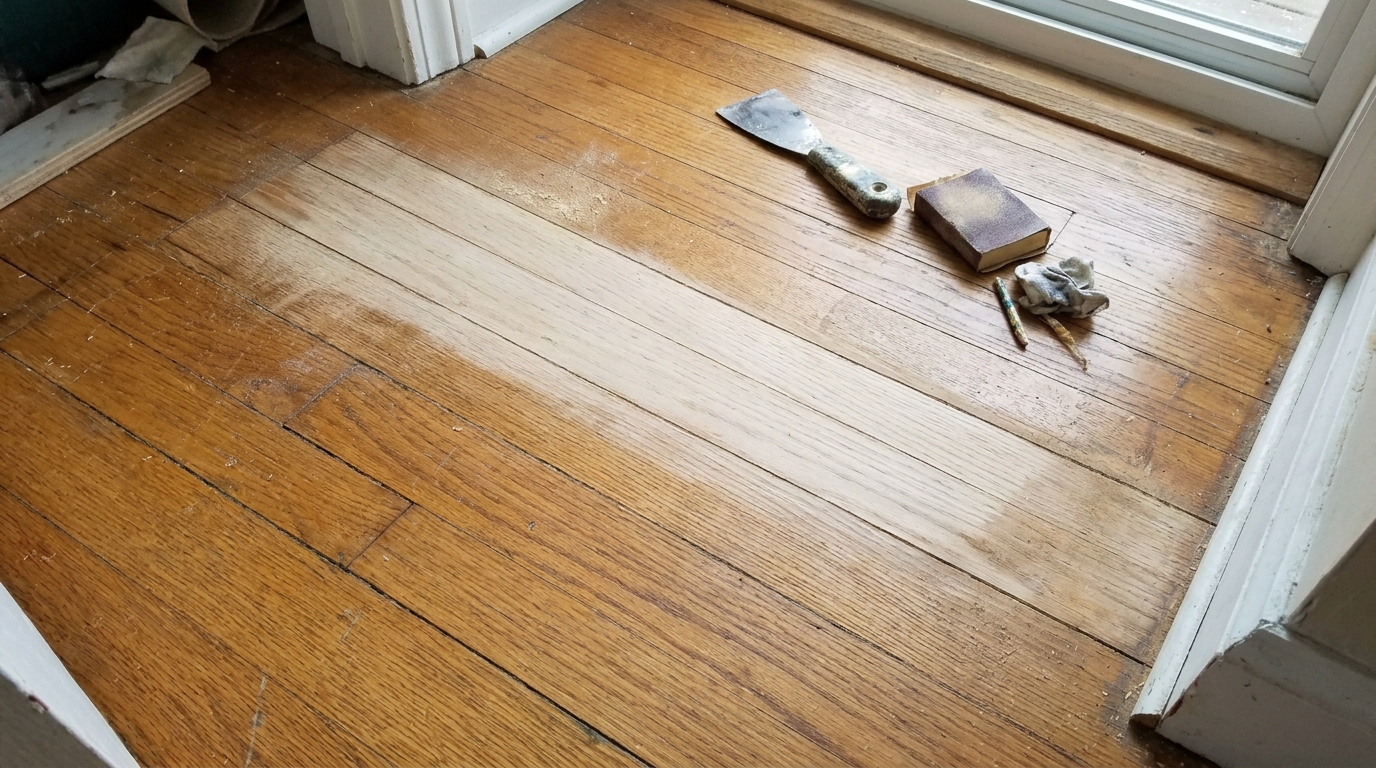
Can hardwood floors be spot refinished? Yes, in the right situation. A small area with a stain, a burn, a deep scratch, or a worn patch can often be fixed without redoing the whole room. But the result depends on how well the new finish blends in with the old, and that’s where many spot repairs go wrong.
Quick answer: Spot refinishing works best on small, contained damage that has a clear edge, like a single board, a pet stain, or a gouge. Done well, it’s invisible or close to it. Done in the wrong place, it leaves a visible patch because new finish rarely matches old, aged finish exactly. When damage is spread out, or the whole floor looks worn, refinishing the full room usually looks better.
Here’s how to tell which situation you’re in, what the repair involves, and when a bigger job is the smarter call.
What spot refinishing actually means
Spot refinishing is a repair to one part of a floor instead of the whole thing. A professional sands the damaged area, matches the stain if needed, applies finish, and blends the edges into the surrounding floor.
It’s different from a full hardwood floor refinishing job, where every board in a room gets sanded and finished together. It’s also different from a screen and recoat, which refreshes the finish over a wide area without cutting into the wood. We explain that option in our guide to refinishing hardwood floors without sanding.
Can hardwood floors be spot refinished? When it works well
A spot repair is a good fit when:
- The damage is small and in one place, such as a burn, a deep scratch, or a dent
- A pet stain or water mark affects one or two boards
- A board was replaced and needs to be finished to match
- The surrounding finish is in good condition
- The damage sits near a natural boundary, such as a doorway, a board end, or a change in direction
- The floor has a satin or matte sheen, which hides slight differences better than gloss
The more contained the damage is, the better the odds of a clean result.
When spot refinishing doesn’t work
It’s usually the wrong choice when:
- The whole floor looks dull, worn, or scratched in many places
- The finish is wearing through in traffic lanes, like hallways and in front of kitchen counters
- The damage is wide and uneven, with no clean edge to stop at
- Years of wax or polish are on the floor, which can cause the new finish to peel or look different
- The floor has a high-gloss finish, which shows every difference
- The surrounding finish is very old and has aged to a different shade
In these cases, a patch tends to stand out, and you can end up paying for a repair you still don’t like.
Why spot repairs sometimes show
The tricky part isn’t the sanding. It’s matching something new to something that’s been aging for years.
The finish has changed color over time
Oil-based finishes darken and turn more amber as they age. A fresh coat in the same product starts out lighter and clearer, so the patch can look pale next to the old floor. Water-based finishes stay clearer, but they won’t match an aged oil finish either. Sunlight also changes the wood’s color over time, so the area around the repair may have shifted.
The sheen doesn’t match
Even a small difference in sheen shows up under angled light. A new coat that’s a little glossier or flatter than the old one can create a visible rectangle.
The edges are hard to hide
Finish applied to a small area can leave a faint line where it meets the old surface. Good technique, working with the board lines and feathering the edges, makes a big difference. This is where experience shows.
The wood and stain differ
If the floor is stained, the repair needs to match that color on bare wood. Different boards take stain differently, so a patch can come out darker or lighter than the area around it. We cover how species and stain interact in our guide on staining hardwood floors a different color.
Pro Tip: Run a fingernail across the scratch. If your nail doesn’t catch, the scratch is only in the finish and may be fixable with a light buff or a touch-up. If your nail catches in a groove, the damage is in the wood and the area needs sanding.
Which damage can be spot repaired
| Type of damage | Spot refinish possible? | Notes |
|---|---|---|
| Light surface scratches | Often | May only need buffing or a touch-up |
| Deep scratches and gouges | Often | Needs sanding and sometimes filler |
| Pet urine stains | Sometimes | Dark stains can go deep, may need board replacement |
| Water rings and white marks | Often | Depends on how far the moisture reached |
| Burns and heat marks | Sometimes | Deep burns may need the board replaced |
| Dents | Sometimes | Can be steamed or sanded out |
| Wide worn traffic lanes | Rarely | Better handled with a recoat or full refinish |
| Cupped or buckled boards | No | Fix the cause first; see our guides on cupping and buckling |
How spot refinishing is done
- Assess the damage. The depth, cause, and size are checked, and the finish type is identified if possible.
- Clean the area. Dirt, oils, and any wax or polish are removed so the new finish can bond.
- Sand the spot. The damaged area is sanded and feathered outward so the repair has no hard edges.
- Repair if needed. Gouges are filled, or a damaged board is replaced. For this kind of work, our hardwood floor repair service is the starting point.
- Match the color. Stain is tested and applied if the floor is stained.
- Apply finish. Coats go on and are blended into the surrounding area.
- Cure. The spot needs time to dry and harden before regular use.
The skill is in steps three and six. Sanding too wide leaves a dip, and applying finish with the wrong technique leaves a visible edge.
Spot refinishing vs refinishing the whole room
| Spot refinish | Whole room refinish | |
|---|---|---|
| Cost | Lower | Higher |
| Time | Hours to a day or two | Several days |
| Match risk | Higher | Low |
| Best for | Small, contained damage | Widespread wear or visible mismatch |
| Impact on wood thickness | Minimal | Removes a thin layer across the room |
A common middle path is to repair the damaged boards and then refinish the full room so everything matches. If you’re weighing cost against appearance, our hardwood flooring cost guide lays out typical prices for each option.
Can you spot repair a floor yourself
Small touch-ups are possible, but go carefully.
What homeowners can usually do:
- Use a touch-up marker or wax filler stick for light scratches
- Clean up a fresh spill right away
- Use felt pads and mats to prevent more damage
What’s risky:
- Sanding and refinishing a patch without experience
- Using polish or wax products to hide damage, because they can interfere with future finishing
- Buying a random stain and applying it to a small area
Finish manufacturers publish compatibility guides, and Bona’s resources are a useful place to check before you put anything on your floor. If you plan to hire a pro later, ask them before you try a product, since some leave residues that cause problems.
Spot refinishing engineered hardwood
It depends on the thickness of the top layer. Engineered boards have a thin hardwood veneer, and sanding takes some of it away. A very light spot repair may be fine, but heavy sanding on a thin veneer can go straight through to the core. Check the wear layer before anyone sands. Our guide to refinishing vs replacement explains how thickness limits your options.
Spot repairs in Calgary homes
A few local things are worth knowing.
Dry winter air. Our indoor air gets very dry when the furnace runs, and boards shrink. Filler used in a seam or gap can crack or pop out later, so timing and product choice matter. Our guide to hardwood floor gaps in Calgary winters explains seasonal movement.
Older homes. In older areas like Inglewood and Bridgeland, original floors often have many layers of finish and decades of aging. Matching new finish to that is harder, and a full room refinish can look better than several patches.
Timing. Fall is a good time for repairs, before winter dryness sets in and while windows can still be opened for ventilation during drying.
How much does spot refinishing cost
These are rough Calgary estimates, not quotes.
| Repair | Typical cost |
|---|---|
| Light scratch touch-up or buff | Often $100 to $300 |
| Gouge or deep scratch repair | About $200 to $500 |
| Single board replacement and finishing | About $50 to $150 per board, plus finishing |
| Full room refinish | About $3 to $6 per sq ft |
Many contractors have a minimum charge for small jobs because of setup and travel. If you have several small problems, bundling them into one visit can save money.
Common spot refinishing mistakes
- Trying to fix wide wear with a small patch. It tends to highlight the problem.
- Ignoring the finish type. Mixing incompatible products can cause peeling or cloudy results.
- Skipping a sample or test spot. Always check the match somewhere hidden first.
- Using wax or polish to cover damage. It can block future refinishing.
- Going too deep with sanding. This weakens a thin floor and leaves a visible dip.
- Not fixing the cause. If a stain came from a leak, the moisture must be dealt with first.
Frequently asked questions
Will a spot refinish match my existing floor?
Often it will be close, especially with a satin or matte finish and a contained repair. Perfect matches are less common on older floors, because the surrounding finish has aged.
Can you refinish just one board?
Yes, in many cases. Done well, a single sanded or replaced board and a blended finish can be hard to see. Boards in high-traffic or high-visibility spots are harder to hide.
How long does a spot repair take?
Many are done in a day or two, depending on the type of damage and the finish. Cure time before heavy use is longer, so follow your contractor’s instructions.
Can you spot refinish a floor with polyurethane?
Yes. Most modern floors have a polyurethane finish, and it can be sanded and recoated. The new finish has to be compatible with what’s already there.
Is it better to replace a damaged board or refinish it?
If the damage is deep, such as a heavy stain, a deep burn, or structural damage, replacing the board is often cleaner. If it’s only the surface, refinishing is usually enough.
Should I refinish the whole floor instead?
If you have several damaged areas, general wear, or a patch that would be visible from many angles, a full refinish often looks better and avoids a mismatch.
Choosing the right repair for your floor
So, can hardwood floors be spot refinished? Yes, when the damage is small, contained, and easy to blend. When it’s spread out or the surrounding finish is very worn, a larger refinish usually gives a better, more even look and is worth the extra cost.
If you’re not sure which route suits your floor, contact Arbutus Hardwood for a free assessment in Calgary, Airdrie, Cochrane, Okotoks, Chestermere, or nearby. We’ll look at the damage, tell you plainly whether a spot repair will blend, and show you the options. You can also read about our hardwood floor polishing service for finish refreshes, or see whether you can paint hardwood floors if damage is beyond saving.