

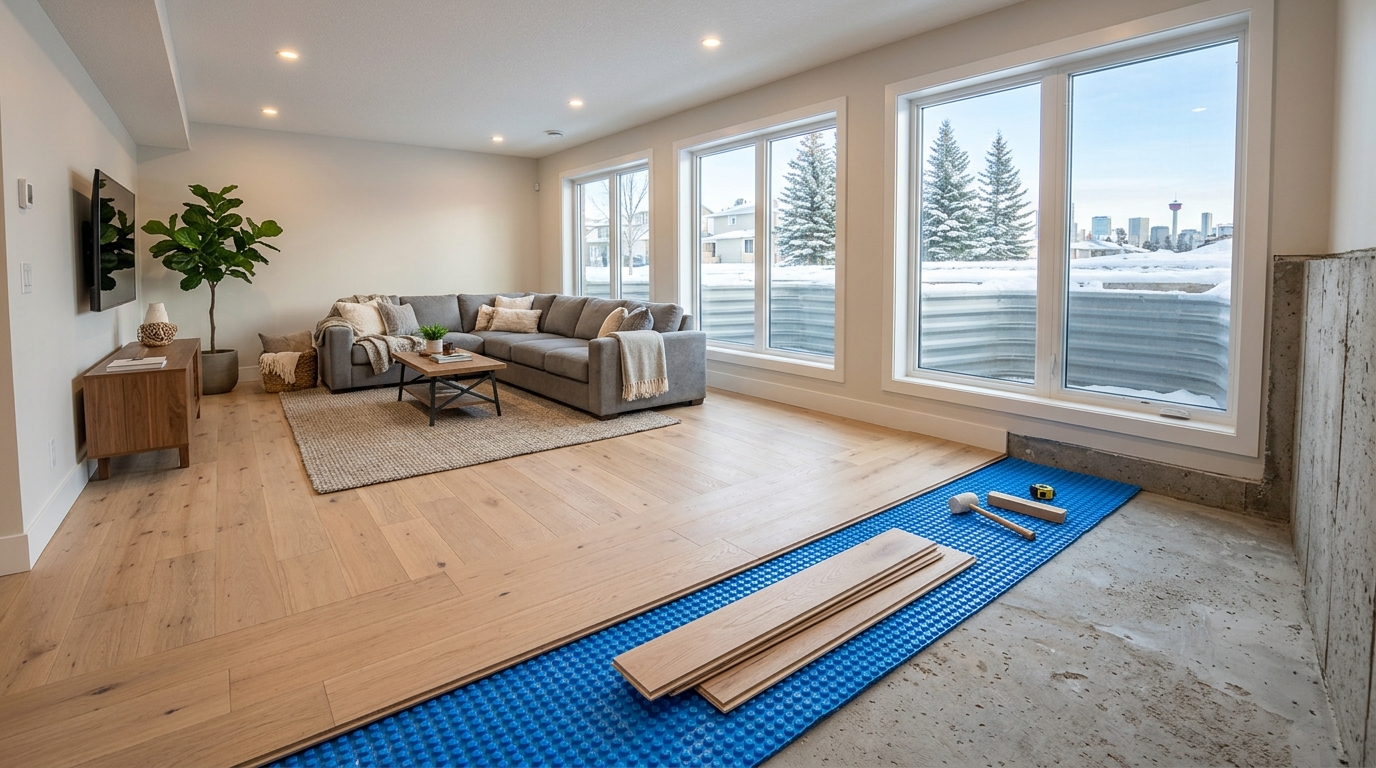
Hardwood floors in basement spaces are possible, but only with the right product and the right prep. Most basement floors sit on concrete below ground level, which is the hardest place in a house for wood to survive. Get it right and you have a warm, good-looking lower level. Get it wrong and you can end up with cupped boards, mold, and a floor you have to rip out.
Quick answer: Solid hardwood isn’t recommended in basements because it reacts badly to moisture and humidity. Engineered hardwood can work if the concrete slab passes a moisture test and the installation includes proper moisture protection. LVP is usually the safer, cheaper choice when moisture is a real concern. The deciding factor isn’t the flooring brand. It’s the condition of your slab.
Here’s what to check, what your options are, and how to decide between engineered hardwood and LVP for a Calgary basement.
Why basements are hard on wood
Wood takes on and gives off moisture with the air and surfaces around it. A basement concentrates the problems:
- Concrete holds moisture. Even a slab that looks dry can release water vapor upward.
- Below-grade humidity swings. Summer humidity can spike, and winter air can swing the other way.
- Less airflow and less heat. Cooler, still air makes moisture issues worse.
- Plumbing and water risk. Water heaters, sump pits, and laundry areas leak or overflow sometimes.
This is the same moisture imbalance behind problems we cover in our guides on cupping and buckling. In a basement, those risks are higher.
Hardwood floors in basement: what about solid hardwood?
In most cases, don’t. Solid hardwood expands and contracts more than engineered wood, and it needs a wood subfloor to be fastened to. Below grade, with moisture coming through concrete, that’s a risky combination. Industry guidance, such as installation guidelines from the National Wood Flooring Association, generally steers solid hardwood away from below-grade spaces.
If you love the solid wood look, the better route is to put it on the upper floors and use something more moisture-tolerant in the basement.
Hardwood floors in basement: can engineered hardwood work?
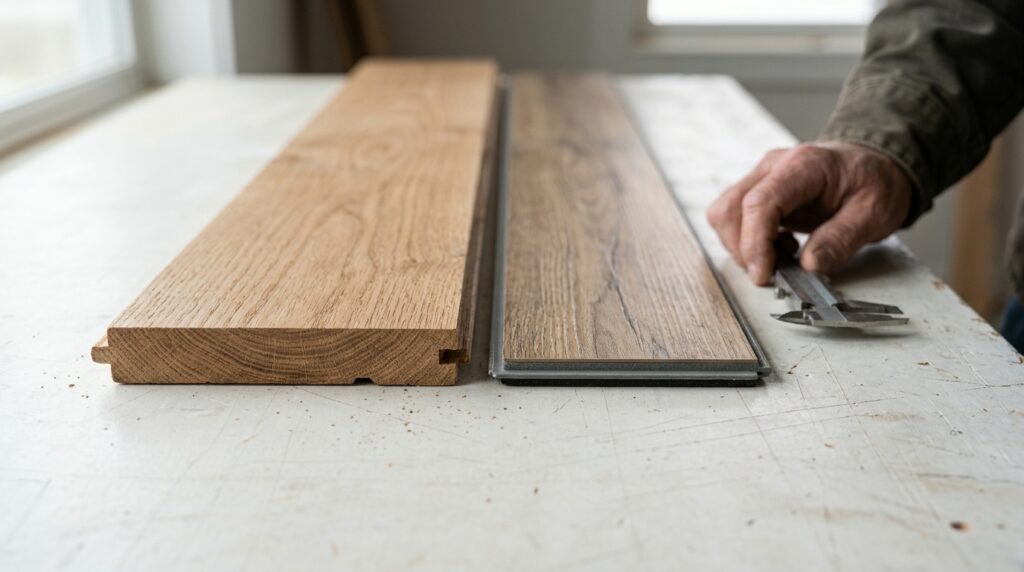
Often, yes. Engineered hardwood has layered plywood construction that resists movement better than solid planks. That makes it the wood option most commonly used below grade.
It still isn’t waterproof. Conditions that need to be true:
- The concrete slab is flat and tests dry
- A moisture barrier or suitable subfloor system is used
- Indoor humidity is kept in a stable range, roughly 30 to 50 percent
- The product is rated for below-grade use by the manufacturer
- The installation method matches the product and the slab
If any of those fail, engineered hardwood can still cup or fail, just more slowly than solid wood would.
Test your slab first
Skipping the moisture test is the most expensive mistake in basement flooring.
Pro Tip: Tape a one-foot square of clear plastic sheet tightly to the concrete and leave it for 48 to 72 hours. If you see condensation underneath or the concrete looks darker, moisture is coming up through the slab. This is only a rough screen, not a replacement for professional testing, but it’s a free first check.
Professional testing uses methods like relative humidity probes set into the concrete, or calcium chloride tests that measure how much moisture vapor leaves the slab. The results tell your installer whether the slab is dry enough, or whether a moisture barrier or other fix is needed. A reputable installer will test before quoting, not after the boards are in.
Hardwood vs LVP in a basement
| Engineered hardwood | LVP | |
| Typical installed cost per sq ft | $8 to $14, plus moisture protection | $4 to $9 |
| Water resistance | Low to moderate | High |
| Handles slab moisture | Only with proper prep | Better, but still needs a moisture check |
| Feel | Warm, real wood | Slightly softer, can feel hollow |
| Can be refinished | Sometimes, once or twice | No |
| Risk if there’s a flood | Likely damage | Often survives, planks can be dried or replaced |
| Resale appeal | Strong | Moderate |
These are rough estimates, not quotes. For a full comparison across all flooring types, see our guide on hardwood vs LVP, laminate and carpet.
Choose engineered hardwood if: the slab tests dry, the basement is a finished living space, you want the look and feel of real wood, and you’ll keep humidity controlled.
Choose LVP if: the basement has a history of leaks, the slab tests damp, you have a laundry room, bar sink, or bathroom nearby, you’re on a tighter budget, or you want the lowest risk.
One caution: LVP doesn’t make moisture go away. If a slab is wet, moisture can get trapped under vinyl and lead to mold and odor, even though the plank itself isn’t harmed. The slab should be tested no matter which floor you pick.
Installation methods for basement floors
Floating. Planks click or lock together and aren’t glued to the slab, so they sit over an underlayment with a moisture barrier. It’s common for engineered hardwood and LVP in basements.
Glue-down. Planks are adhered directly to the concrete with an adhesive made for the product and for moisture. It gives a solid feel but needs a very well-prepped slab.
Raised subfloor systems. Panels or a plywood subfloor go over the concrete, sometimes with a dimpled membrane, to create an air gap and a surface for fastening. They add height and cost, but they help in damp or uneven basements.
Which works depends on slab condition, ceiling height, and the product. A professional installer can recommend a system after testing. Our hardwood floor installation team handles this kind of assessment.
Calgary basement considerations
Concrete slab and finished basements. Many Calgary homes have poured concrete basements, and newer builds in areas like Mahogany, Seton, and Panorama Hills often have basements finished soon after construction. New concrete can hold moisture for a long time while it cures, so testing matters even in newer homes.
Dry winter air. Basements are often cooler and less affected by furnace dryness than upper floors, but humidity still moves with the seasons. A hygrometer and, if needed, a dehumidifier or humidifier help keep it stable. Our guide on hardwood floor gaps in Calgary winters explains how seasonal humidity affects wood.
Flood-prone areas. Homes near rivers and creeks in older parts of the city can face higher risk of basement water. If your area has a history of flooding or sump pump trouble, LVP is often the safer choice. For general guidance on moisture and indoor humidity, the Canada Mortgage and Housing Corporation has resources.
In-floor heat. Many newer basements include radiant heating. Check that your flooring is rated for use over radiant heat, because temperature limits and installation rules apply.
How much do basement floors cost
These are rough Calgary-area estimates.
| Item | Typical cost |
| Engineered hardwood, installed | $8 to $14 per sq ft |
| Moisture barrier or subfloor system | Adds roughly $2 to $6 per sq ft |
| Concrete moisture testing | Quoted per job |
| LVP, installed | $4 to $9 per sq ft |
For a bigger picture on hardwood pricing, see our hardwood flooring cost guide.
Mistakes to avoid
- Skipping moisture testing. This is the number one cause of basement floor failures.
- Installing solid hardwood below grade. The risk is much higher than with engineered products.
- Ignoring humidity. A dehumidifier and a hygrometer are inexpensive protection.
- Using the wrong adhesive or underlayment. Products are not interchangeable.
- Covering a damp slab. Fix moisture first, then install.
- Forgetting about water sources. Laundry rooms and bars need extra thought.
If boards start to lift or curl after installation, don’t wait. Early repair is much cheaper, and our hardwood floor repair service can assess the damage.
Frequently asked questions
Can you put hardwood in a basement with a concrete floor?
Engineered hardwood can be, if the slab tests dry and moisture protection is used. Solid hardwood generally shouldn’t be.
Is engineered hardwood waterproof?
No. It handles moisture better than solid wood, but standing water and long-term dampness can damage it.
What flooring is best for a basement that floods?
LVP and tile are usually the most forgiving. Neither is immune, and the slab and walls still need to be dried properly after any water event.
Do I need a vapor barrier under basement flooring?
Often yes, depending on the product and your slab test results. The right barrier depends on the flooring type and the installer’s recommendation.
Can I put hardwood over radiant heat in a basement?
Some engineered products are made for it, with temperature limits and specific installation rules. Always check the manufacturer’s guidelines.
How long should I wait before installing flooring on a new basement slab?
New concrete can take a long time to dry, and testing is the only reliable way to know. Don’t rely on a calendar alone.
Choosing the right floor for your basement
For hardwood floors in basement spaces, the safest approach is to start with the slab, not the flooring. Test for moisture, choose a product made for below grade, and be honest about how much water risk your space has. Engineered hardwood can give you a beautiful result when conditions are right, and LVP is the sensible pick when they’re not.
If you’re planning a basement floor and want a straight answer on what will work, contact Arbutus Hardwood for a free assessment in Calgary, Airdrie, Cochrane, Okotoks, Chestermere, or nearby. We’ll check the conditions, explain your options, and give you a clear quote. You can also see our custom hardwood flooring service if you want something specific.