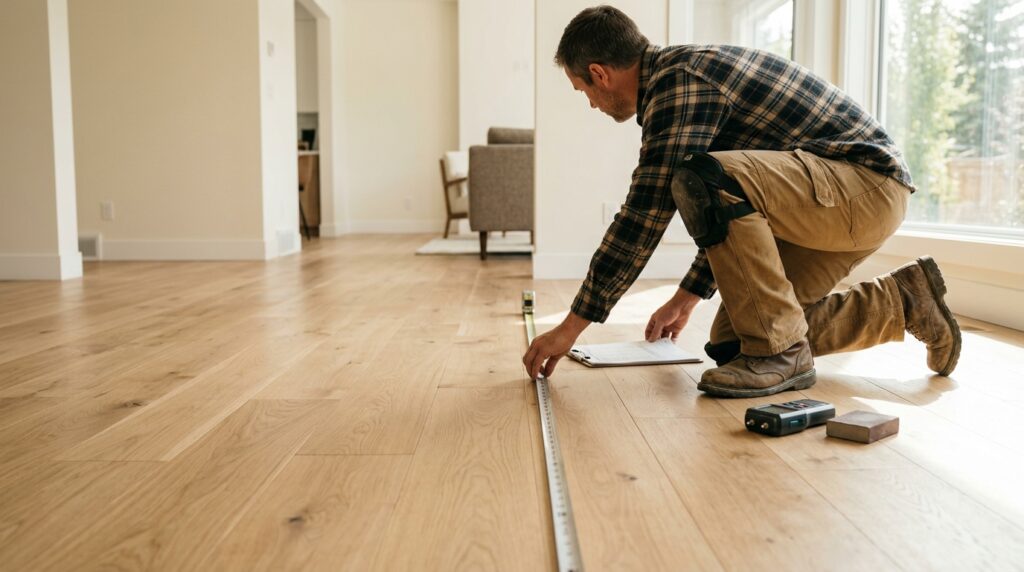
Wide plank flooring is having a moment. Walk into any new build or renovated home right now and there’s a good chance you’re standing on boards wider than what your grandparents had.
But wider isn’t automatically better. It changes how a floor looks, how it’s installed and how it behaves in a dry climate like Calgary’s.
I’ve spent years installing, refinishing and repairing hardwood floors. Wide plank jobs come with their own rules. This guide covers what wide plank flooring actually is, which species and widths work best, what it costs and where it can go wrong if it’s not handled right.
Most of what’s written about wide plank flooring online comes from writers in Georgia or California, places where humidity barely moves and wood behaves itself year-round. That’s not the world we live in here. A Calgary winter can drop indoor relative humidity into the teens. A wide plank floor feels every point of that swing far more than a narrow strip floor does. Keep that in mind as you read the rest of this.
What is wide plank flooring?
Standard hardwood boards run 2 ¼ to 3 inches wide. That’s the classic strip flooring you’ve seen in older Calgary homes for decades.
Wide plank flooring starts around 4 inches and can go up to 10 inches or more, depending on the species and manufacturer. Some specialty mills cut boards 12 inches wide or beyond, though anything past 7 or 8 inches gets into custom territory fast.
The wider the board, the more of the tree’s natural grain, knots and color variation you see on each piece. Fewer seams across a room. A calmer, less busy floor.
How width changes the look of a room
Narrow strip flooring reads as traditional and formal. Wide planks read as relaxed, rustic or modern, depending on the finish.
A 3-inch oak floor in a small dining room can feel choppy, with dozens of seams breaking up the sightline. Swap that for 6-inch boards and the same room feels bigger and calmer. Fewer lines for your eye to trip over.
Solid vs engineered wide plank flooring
This is the decision that matters most. It’s where a lot of homeowners get steered wrong by a salesperson pushing whatever’s in stock.
Solid hardwood is one piece of wood, top to bottom. You can sand and refinish it multiple times over its life, which for a wide plank floor can mean decades of use.
Engineered hardwood has a real wood veneer bonded to layers of plywood underneath. That layered core resists the expansion and contraction that comes with Calgary’s dry winters and humid summer swings.
Here’s the part most flooring guides skip: width and stability are directly related. A 3-inch solid oak board moves a little with the seasons. A 7-inch solid board moves a lot more, because there’s simply more wood to expand and contract.
That’s why engineered construction is often the smarter call once you go past 5 or 6 inches wide. I’ve broken this down in more detail here:solid vs engineered hardwood in Calgary.
Feature
Solid wide plank
Engineered wide plank
Can be refinished
Yes, multiple times
Usually 1 to 3 times, depends on veneer thickness
Stability in dry climates
Lower, more prone to gaps
Higher, built for movement
Best board width
Up to 5 inches
5 to 10+ inches
Typical lifespan
50+ years
25 to 40 years
Installation methods
Nail-down
Nail-down, glue-down, floating
Best wood species for wide plank floors
Not every species holds up well at wider widths. Softer, more open-grained woods tend to show more movement.
White oak is the most popular choice for wide plank right now, for good reason. It’s dense, has a tight grain and stains evenly across a wide board.
Red oak is a close second and usually a bit cheaper, though it has a slightly pinker undertone that shows more at wider widths.
Walnut looks incredible in wide plank, with deep chocolate tones and dramatic grain. It’s also softer than oak, so it’s not the best pick for high-traffic areas like entryways or kitchens.
Hickory and maple work too, but their tighter, busier grain patterns can look overwhelming once you get past 6 inches. Oak tends to stay the safer bet for most living rooms and main floors.
If you’re stuck between red and white oak specifically, I wrote a full breakdown here:red oak vs white oak flooring. And if you want the full species lineup, including walnut and maple, that’s covered inour hardwood species guide.
Pros of wide plank flooring
Fewer seams, more character. Each board shows more of the tree’s natural grain. That variation is the whole appeal for a lot of homeowners.
Faster installation, in theory. Fewer boards means fewer pieces to lay per square foot. In practice this gets offset by the extra care wide boards need, so the time savings aren’t as big as people expect.
Makes small rooms feel larger. Fewer lines breaking up the floor plane reads as more open space.
Works with more design styles. Wide plank floors show up in farmhouse kitchens, mid-century remodels and modern new builds equally well. It’s one of the more flexible flooring decisions you’ll make.
Cons of wide plank flooring
More visible movement. Wider boards show gaps and cupping more obviously than narrow strip flooring when humidity swings hit. You’ll notice it faster on a 7-inch board than a 2 ¼-inch one.
Higher cost. Wider boards mean more waste at the mill and slower kiln drying. That gets passed on to you.
Installation needs more skill. Subfloor flatness matters more with wide boards. A dip that’s invisible under narrow strip flooring can show up as a rock or a squeak under a wide plank.
Fewer refinishing cycles for engineered options. If you go engineered to solve the stability problem, you’re trading off some of the lifetime refinishing solid wood offers.
I go into more depth on subfloor prep and installation methods in this guide onnail-down vs glue-down hardwood floors, which matters even more once boards get wider.
Wide plank flooring installation: what’s different
Wide boards are less forgiving than narrow ones. A carefulinstallation crew catches problems a rushed one won’t. A few things change on the install side.
Subfloor prep gets stricter. Most manufacturers want flatness within 3/16 inch over a 10-foot span for wide plank, tighter than what’s needed for standard strip flooring.
Acclimation takes longer. Wide boards need more time sitting in the room before installation so they can adjust to your home’s humidity. Rushing this step is the number one cause of gaps down the road.
Fastening pattern changes. Wide solid boards typically need more fasteners per board to keep them from cupping or lifting at the edges.
Expansion gaps need to be sized correctly. Skip this and you’ll see buckling the first dry Calgary winter.
Get any one of these wrong and you’ll be calling someone for repairs within a year or two.
The most common installation mistakes
I’ve walked into more than a few homes where a wide plank floor started failing within its first winter. Almost every time, it comes down to one of these:
Rushed acclimation. Boards were installed within a day or two of delivery, before they’d settled to the home’s actual humidity.
No expansion gap, or too small a gap. The boards were installed edge to edge without room to expand, so they buckled the first humid summer.
Fastening from the wrong end of the board. Wide boards can cup if they’re not fastened evenly across their width, not just at the edges.
Installing over an uneven subfloor. A dip of even a quarter inch can telegraph up through a wide board as a squeak or a soft spot.
Ignoring the home’s HVAC setup. A floor installed in July without accounting for what a bone-dry January will do to it is a floor set up to fail.
None of these are hard to avoid. They just take an installer who’s actually paid attention to how wide boards behave, not someone treating it the same as a standard strip job.
Wide plank flooring styles and trends
A wide plank isn’t one look. It stretches across several current styles.
Matte, low-sheen finishes on white oak, which soften the wide board’s visual weight
Wire-brushed or hand-scraped textures that hide minor dents and wear, popular in busy households
Gray and warm-neutral stains, a shift away from the orange-toned oak that dominated the 2000s
Herringbone and chevron patterns cut from wider boards, giving a bold geometric look without the busyness of narrow-plank herringbone
How wide plank floors handle Calgary’s dry climate
This is where a lot of national flooring guides fall short, because they’re written for climates that don’t see 20% humidity in January.
Calgary winters pull moisture out of everything, wood included. When a solid wide plank floor loses moisture, it shrinks. Do that every winter for a few years and you’ll see gaps opening between boards, sometimes wide enough to catch a coin.
Come summer, the reverse happens. Boards pick up moisture, expand and press against each other. If there wasn’t enough expansion gap left at installation, that pressure has to go somewhere. Usually that’s cupping or buckling.
TheNational Wood Flooring Association recommends acclimating wood flooring to the room’s expected in-use humidity range before installation, not just to whatever the humidity happens to be on delivery day. That’s a detail a lot of installers skip. It’s usually the first thing I check when I’m called out to fix a wide plank floor that’s failing early.
If you’re set on solid wide plank in Calgary, plan on running a humidifier through the winter months. If that’s not realistic for your household, engineered construction solves most of this problem for you.
Cost of wide plank flooring
Wide plank costs more than standard strip flooring, generally 15 to 30% more per square foot for the same species. A few reasons why:
Wider boards mean more waste at the mill, since fewer boards can be cut from each log without defects
Kiln drying takes longer for wider stock, tying up equipment longer
Grading is stricter, since flaws are more visible on a bigger surface
Rough Calgary pricing for materials alone, installed:
Wood type
Width
Price range per sq ft (installed)
Red oak, solid
5 inch
$9 to $13
White oak, solid
6 to 7 inch
$12 to $18
White oak, engineered
7 to 9 inch
$10 to $16
Walnut, engineered
6 to 8 inch
$14 to $22
Brand matters too. Some manufacturers charge a real premium for consistent milling and grading. With a wide plank, that consistency is worth paying for. I put together a comparison here:best hardwood flooring brands in Calgary.
Caring for wide plank floors long term
Wide plank floors don’t need much day to day, but a few habits go a long way.
Run a humidifier through the winter months and aim for somewhere between 35 and 50% indoor relative humidity. That single habit prevents more gapping problems than anything else on this list.
Wipe up spills fast, especially near wide seams. Water sitting in a seam for hours is one of the quickest ways to see localized cupping on a single board.
Use furniture pads and avoid dragging heavy items across the floor. Wide boards show scuffs and gouges just as clearly as they show grain, maybe more so, since there’s more flat surface area to catch the light.
Stick to a cleaner made for hardwood, not an all-purpose spray. Anything with excess water or wax buildup causes more harm on wide boards than narrow ones, since moisture has more surface to sit on before it evaporates.
Is wide plank flooring right for your home?
A wide plank makes sense if you’ve got open-concept living spaces where fewer seams read as a bigger, calmer floor plan. It also suits homes going for a farmhouse, rustic or modern aesthetic where natural grain variation is the point.
It’s a tougher sell in a tight, older home with an uneven original subfloor, unless you’re prepared to invest in leveling first. And if you’re not willing to manage indoor humidity through the winter, a solid wide plank probably isn’t your best bet.
A lot of our clients land on a middle ground: engineered wide planks in the 5 to 7 inch range, wide enough to get the visual benefit, stable enough for our climate. That’s a conversation worth having before you order material. It’s exactly what we help homeowners work through in ourcustom hardwood flooring consultations.
The bottom line
Wide plank flooring gives you a calmer, more open-looking floor with real character in the grain. It also asks more of your subfloor, your installer and your home’s humidity control, especially here in Calgary.
Get the species, width and construction type matched to your home and it’ll be one of the best upgrades you make. Get it wrong and you’ll be dealing with gaps and cupping by the second winter.
If you’re weighing your options, we’re happy to walk through what’ll actually hold up in your home.Get in touch with us for a clear, honest quote.
Generally, yes. Fewer seams across the floor create a more continuous surface, which tends to make a room read as more open. It's a small design trick, but it works.
It depends what matters most to you. Engineered wins on stability and is often the better choice for wide boards in a dry climate. Solid wins on total lifespan if you're planning to refinish the floor several times over the decades.
Most standard product lines top out around 7 to 8 inches. Custom mills can go wider, sometimes past 10 inches, but boards that wide need extra acclimation time and a near-perfect subfloor.
A little, mostly because there's more surface area per board to notice a mark on. Matte and wire-brushed finishes hide wear better than high-gloss finishes.
Yes, but engineered construction is strongly recommended. Solid wide boards over radiant heat are far more prone to gapping from the constant, uneven moisture loss.
For an average main floor, plan on 3 to 5 days including acclimation time, longer than standard strip flooring because of the extra prep work involved.
How to choose a hardwood flooring contractor in Calgary Learn how to choose a hardwood flooring contractor in Calgary by checking experience, insurance, past projects and written quotes before you hire. Contact Us Your floors will be under your feet for 20 years or more. The person you hire to…
Hardwood Flooring Cost in Calgary: What You’ll Actually Pay Planning your project but unsure about hardwood flooring cost in Calgary? This guide explains installation, refinishing, and repair expenses to help you plan your flooring budget. Contact Us If you’re planning to install, repair, or refinish hardwood flooring in Calgary, understanding…
Matte vs gloss hardwood flooring: which finish is right for your home? Matte vs gloss hardwood flooring, see which finish suits Calgary homes best for durability, style & upkeep. Get expert advice from Arbutus Hardwood. Contact Us Matte vs gloss hardwood flooring feels like a small decision until you’re standing…