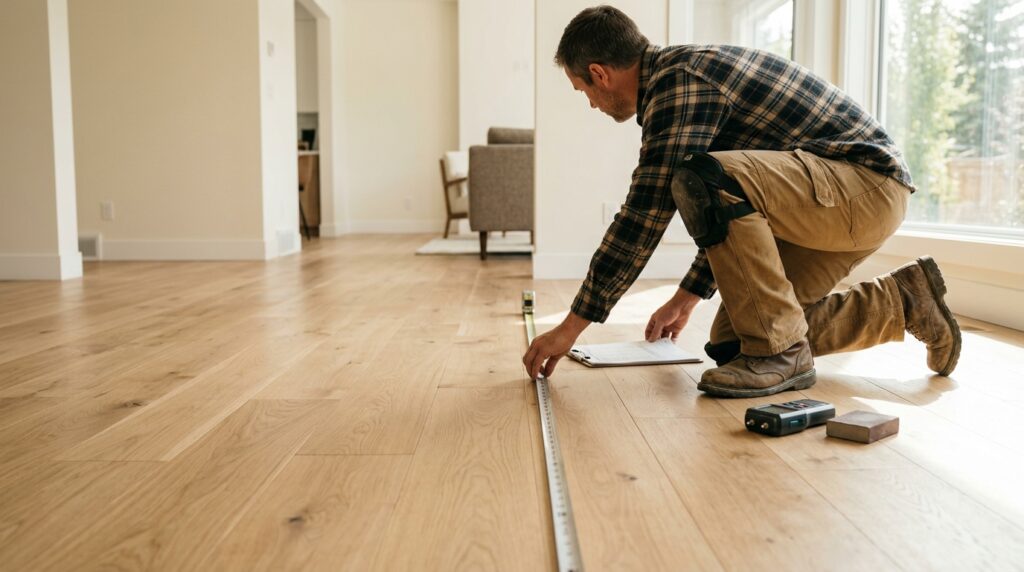
Compare the top hardwood flooring species for Calgary homes, from oak to ipe, with honest tips on durability, cost, maintenance and Calgary climate fit.
Hardwood flooring is one of the highest-value upgrades you can make to a Calgary home. It changes how a room feels, and it holds resale value in a way most other renovations don’t. Real estate agents will tell you the same thing: buyers notice hardwood before they notice almost anything else in a listing photo.
But picking the right hardwood flooring species isn’t just a color decision. Calgary’s climate is hard on wood. Dry winters, big humidity swings, chinooks that flip the weather overnight, it all adds up. A floor that performs great in Toronto or Vancouver can gap, cup or crack here within a year if it’s the wrong species for the job.
We’ve installed and refinished floors across Calgary for over 3 decades, and the same pattern shows up every time. Homeowners fall in love with a photo online, order the wood, and only find out afterward that it wasn’t built for a Prairie climate. That’s an expensive mistake to fix after the fact.
This guide covers the wood species we see most often in Calgary homes, how each one actually holds up locally, and how to pick one without guessing. By the end, you’ll know which species fits your household, your budget and the room you’re flooring.
Why wood species selection matters for Calgary homes
This isn’t a style choice you make once and forget. The species you pick affects how your floor performs for the next 20 to 30 years.
Wood moves. That’s not a defect, it’s physics. And in Calgary, where indoor humidity swings harder than most cities, that movement is more pronounced. So the species you choose has to be able to handle it.
Three things decide how well a floor holds up:
Durability
Grain behavior
Moisture response
This is also why so many homeowners weigh asolid vs engineered hardwood decision before they even think about species. The construction type changes how much that natural movement actually matters.
Density plays a bigger role than most people expect. According to theWood Database, hardness on the Janka scale can vary by more than 300% between common flooring species. That’s the difference between a floor that shrugs off a dropped cast iron pan and one that dents from a dining chair.
Get these three factors right and the floor stays flat, tight and good-looking for decades. Get them wrong and you’re looking at gaps, cupping or an early refinish.
Here’s how the most common species stack up on the Janka hardness scale, from softest to hardest:
Species
Approximate Janka rating
Pine
380–870
Cherry
~950
Mahogany
~800–900
Walnut
~1,010
Teak
~1,000–1,155
Red oak
~1,290
Ash
~1,320
White oak
~1,360
Hard maple
~1,450
Hickory
~1,820
Ipe
~3,510
Numbers vary a bit by source and by exact cut, but the ranking holds. Use this table as a starting point, not gospel. Room use matters just as much as the raw number.
Climate considerations for hardwood flooring in Calgary
Calgary winters are brutal on indoor air. Furnaces run constantly, humidity drops, and wood reacts to that dryness whether you notice it or not. Indoor relative humidity here can fall into the 15 to 25 percent range during a cold snap, well below the 30 to 50 percent that most hardwood is designed around.
Small seasonal gaps between planks in winter are normal. Slight expansion in summer humidity is normal too. What isn’t normal is major damage, and that’s a different problem entirely.
A burst pipe. A leaking dishwasher. Spring runoff finding its way through a basement wall. When that happens, you’re not dealing with seasonal movement anymore, you’re dealing with real damage. It’s worth knowing the early signs ofwater-damaged hardwood so you can catch it before it spreads under the whole floor.
For everyday climate management, three things matter most:
Choosing a stable species
Proper acclimation before install
Controlled indoor humidity year-round
Let the wood sit in your home for 5 to 7 days before installation. Run a humidifier in winter, aim for somewhere in the 35 to 45 percent range indoors. These two habits prevent most of the problems homeowners call us about.
How to match a species to your room and lifestyle
Most homeowners overthink the aesthetic and underthink the room. Here’s a simpler way to approach it.
Entryways and mudrooms. These take the most abuse in any Calgary home, especially with winter boots and salt-covered floors half the year. Hickory or oak handle this best. Skip walnut and cherry here entirely.
Kitchens. Dropped pans, chair scrapes, foot traffic all day. Oak and maple are the safest picks. If you want something with more visual punch, ash works well too.
Living and dining rooms. Moderate traffic, more visibility, more time spent looking at the floor up close. This is where walnut, cherry and mahogany earn their price tag.
Bedrooms. Lower traffic than almost anywhere else in the house. Softer, more character-driven species like pine or cherry work fine here, and a primary bedroom is often the one room where a softer wood makes real sense.
Basements. Moisture risk is higher below grade. Engineered construction, regardless of species, is usually the safer call. Teak’s natural moisture resistance also makes it a strong option if you want solid wood down there.
If you have pets or kids, bump your durability priority up a tier no matter which room you’re flooring. A scratch-resistant species in the wrong room still gets scratched.
Oak hardwood flooring
Oak has been Calgary’s default choice for decades, and it’s earned that spot. It’s durable, reasonably priced and flexible enough to work in almost any style of home.
The grain does a lot of the heavy lifting here. It’s strong and visible, which means everyday scratches and small dents blend right into the pattern instead of standing out. Smoother woods don’t get that luxury.
If you’re stuck between the two most common oak varieties, our breakdown ofred oak vs white oak covers how they differ in tone, hardness and grain.
Oak also takes stain evenly, so you’re not locked into one look. Pale Scandinavian, dark walnut-style, anything in between, it all works. The sheen matters just as much as the color though. Our guide onhigh-gloss vs satin hardwood finish breaks down which works best on oak specifically.
Maintenance is simple too. A weekly sweep, a damp mop every couple of weeks and a refinish every 7 to 10 years in high-traffic zones. That’s about as low-effort as solid hardwood gets.
Maple hardwood flooring
Maple looks nothing like oak. Tight grain, smooth surface, a much more uniform appearance. If you want a modern, minimalist floor, this is usually the pick.
It’s harder than oak too, which helps it resist dents and daily wear. But that tight, closed grain makes it more sensitive to humidity changes. Any movement shows up more clearly on maple than it does on oak, so acclimation and humidity control matter more here than with most species.
One thing worth knowing before you commit: maple can blotch during staining if it’s not prepped correctly. A pre-stain conditioner or a professional finish avoids this. Left natural or lightly whitewashed, maple tends to look best and needs the least intervention to get there.
Ash hardwood flooring
Ash sits close to oak on the hardness scale, but the look is completely different. Bolder grain, more dramatic pattern, a lighter, almost blonde tone that brightens a room.
It also has more flex than oak or maple. That flexibility helps it absorb impact rather than dent outright, which is a real practical advantage in busy spaces, not just a nice-sounding feature.
Ash isn’t as widely stocked as oak or maple in Calgary, so lead times can run longer if you’re ordering a large quantity. Worth checking availability early if you’re set on this one.
Walnut hardwood flooring
People choose walnuts for one reason: the color. Rich, dark, warm. Nothing else on this list gives you that depth.
It’s softer than oak or hickory though, closer to 1,010 on the Janka scale. That’s fine in a dining room or primary bedroom. It’s not fine in an entryway with three kids and a dog running through it daily.
Walnut also costs more upfront, usually 30 to 50 percent above oak per square foot. Homeowners who go this route almost always use it in one or two rooms rather than throughout the whole main floor, partly for budget and partly because that concentrated use is what makes it feel special.
Hickory hardwood flooring
Hickory is the toughest domestic species you’ll find. Roughly 1,820 Janka, nearly 50% harder than oak. If your household is hard on floors, this is the answer.
The look matches the toughness. Dramatic color shifts within the same board, sometimes cream to deep brown in a single plank. It’s not subtle, and it’s not trying to be.
Because it’s so dense, hickory is tougher to nail and can be harder on tools during installation. It’s not a serious DIY candidate for most homeowners. Professional installation isn’t optional here the way it might be with a softer species.
Cherry hardwood flooring
Cherry does something no other species on this list does well: it deepens in color as it ages. A few years of sun exposure and it goes from a light reddish tone to something much richer.
It’s soft though, close to walnut in hardness. Save it for formal rooms where you’re buying the look, not the durability.
Direct sunlight speeds up the color change, and it doesn’t always happen evenly. A rug left in place for a few months can leave a visible outline once you move it. Worth keeping in mind if you’re planning to rearrange furniture down the road.
Mahogany wood floors
Mahogany has a fine, even grain and a deep, consistent tone that reads as high-end the second you walk into a room.
It’s moderately hard, softer than oak but more consistent in texture. Homeowners usually save it for a specific space, a foyer or a library, somewhere the visual impact matters more than heavy daily traffic.
Genuine mahogany is also an import, which means pricing and availability shift with supply. If you’re planning a large area, it’s worth locking in your order early rather than assuming it’ll be in stock when you’re ready to install.
Pine wood flooring
Pine is the softest option here. Visible knots, easy dents, a lived-in look that develops fast.
Most people who choose pine want exactly that. It fits the farmhouse or cottage aesthetic where imperfections read as character, not damage.
It’s also usually the cheapest solid wood option on this list, which makes it a reasonable pick for a first hardwood project or a lower-traffic secondary space like a den.
Ipe wood flooring
Ipe is an exotic South American hardwood, and it’s genuinely in a different category. Around 3,510 Janka, roughly three times harder than oak. It also resists moisture and insects on its own.
It costs more and the install is harder (it’s dense enough that you need to pre-drill for fasteners). For homeowners who want the toughest floor available and don’t mind paying for it, this is the pick.
Ipe is more commonly seen on decks and exterior applications than interior floors, but it holds up just as well indoors. If you go this route, source from a supplier who can confirm sustainable harvesting. It matters for the wood and it’s worth asking about regardless.
Teak wood flooring
Teak’s natural oils give it moisture resistance most domestic species can’t touch. It’s the same reason teak shows up on boat decks. Moderate hardness, excellent stability, warm tones that age well.
It’s a strong pick for a mudroom, a sunroom, or any space where humidity swings more than the rest of the house. The tradeoff is price. Teak sits at the top of the cost range here, alongside ipe.
Best hardwood flooring species for high-traffic areas
If durability is your main concern, three species consistently outperform the rest:
Hickory, the hardest domestic option available
Oak, durable and forgiving in daily use
Maple, very hard, though it needs more humidity control
Cost comparison of different wood species
Tier
Species
Budget-friendly
Pine, Ash
Mid-range
Oak, Maple
Premium
Walnut, Cherry
Luxury
Ipe, Teak
Most Calgary homeowners land on oak or maple. Good balance of cost, durability and style. Premium and luxury species usually get chosen for a specific design goal rather than practicality.
If you want to compare specific manufacturers before deciding, our guide to thebest hardwood flooring brands in Calgary breaks down quality and pricing by brand.
Common mistakes when choosing hardwood flooring
Choosing based on looks alone
Ignoring Calgary’s climate
Skipping ongoing maintenance
Skipping professional installation
That last one costs more homeowners than any species mismatch. The debate overnail-down vs glue-down hardwood floors often gets ignored until it’s too late to change course. For a closer look at how these mistakes play out in real homes, see our full guide onhardwood installation mistakes.
Need help with hardwood floor installation?
Picking the right species is the single most important decision in a flooring project. Calgary’s climate doesn’t leave much room for guessing.
If you’re planning a build with specific design needs, ourcustom hardwood flooring service can match the species, finish and layout to your home. And if you’re ready to move forward, contact us and we’ll help you get it right the first time.
With proper acclimation and normal care, most solid hardwood species last 25 to 50 years here. Oak and hickory tend toward the higher end. Softer species like pine or cherry lean toward the lower end, mostly because they show wear sooner, not because the wood itself fails.
Yes, and a lot of homeowners do it on purpose. A common approach is oak or maple in high-traffic areas and something softer like walnut or cherry in a formal dining room or primary bedroom. Just keep the transition points clean, usually at a doorway or a natural break in the layout.
Not necessarily. Hickory beats oak on pure hardness, but oak's grain hides scratches better and it takes stains more evenly. Hardness matters most for households with kids, pets or heavy furniture. For everyone else, grain pattern and finish flexibility often matter more day to day.
A lot. Pine or ash can run several dollars less per square foot than walnut or teak, and exotic species like ipe cost more again on top of that. Installation labor stays roughly the same across species, so the wood itself drives most of the price gap.
Generally, yes. Dark stains and dark species like walnut show dust, pet hair and fine scratches more than lighter oak or ash. It's not a durability difference, just a visibility one. If you want a dark floor without the constant upkeep, ask about a matte or satin finish instead of high-gloss.
Most of them, yes. Oak, maple, walnut and hickory are all common in engineered construction. Exotic species like ipe are harder to find engineered and usually come as solid wood only. If stability is your main concern, engineered construction in your preferred species is often the better route.
How to choose a hardwood flooring contractor in Calgary Learn how to choose a hardwood flooring contractor in Calgary by checking experience, insurance, past projects and written quotes before you hire. Contact Us Your floors will be under your feet for 20 years or more. The person you hire to…
Hardwood Flooring Cost in Calgary: What You’ll Actually Pay Planning your project but unsure about hardwood flooring cost in Calgary? This guide explains installation, refinishing, and repair expenses to help you plan your flooring budget. Contact Us If you’re planning to install, repair, or refinish hardwood flooring in Calgary, understanding…
Matte vs gloss hardwood flooring: which finish is right for your home? Matte vs gloss hardwood flooring, see which finish suits Calgary homes best for durability, style & upkeep. Get expert advice from Arbutus Hardwood. Contact Us Matte vs gloss hardwood flooring feels like a small decision until you’re standing…