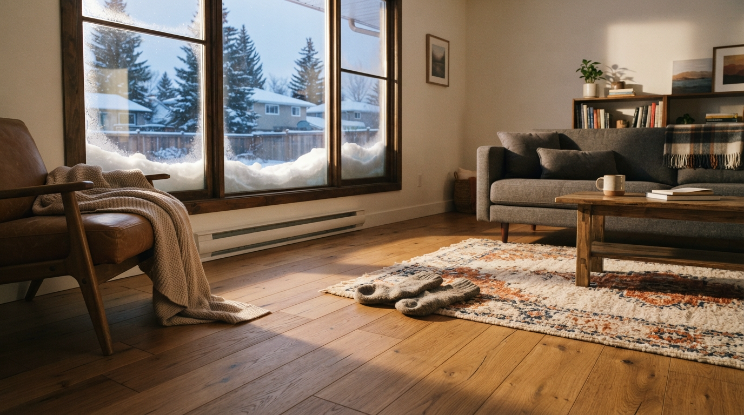
Calgary winters are hard on hardwood. One week you’ve got a chinook pushing 15°C, the next you’re at minus 25 with the furnace running non-stop. That swing dries out the air inside your house fast and your floors feel it before you do.
If you’ve ever noticed thin gaps opening between your boards in January, or a squeak that wasn’t there in the summer, that’s not damage. That’s wood doing exactly what wood does when the humidity drops. The good news: you can prepare hardwood floor for Calgary winters in a weekend and most of it costs nothing but a little attention.
I’ve been fixing, refinishing and installing hardwood in this city for over 30 years. Here’s what actually works.
Why Calgary winters are rough on hardwood floors
Wood is hygroscopic. It absorbs moisture from the air in summer and gives it back in winter. In a coastal city that swing is small. In Calgary, where winter relative humidity indoors can drop into the teens without a humidifier running, the swing is huge.
TheNational Wood Flooring Association recommends keeping indoor relative humidity between 35% and 55% year round to protect wood flooring. Most Calgary homes sit well below that from November through March unless someone’s actively managing it.
Add chinooks into the mix and you get something most flooring guides never mention: rapid freeze-thaw cycles that push and pull moisture out of your wood multiple times a season instead of once. Your floor isn’t just adjusting to winter. It’s adjusting to winter, then a false spring, then winter again, sometimes in the same week.
That’s the real reason a Calgary homeowner needs to prepare a hardwood floor differently than someone in Vancouver or Toronto.
I’ve walked into homes where the owner assumed a contractor from out of province had done something wrong with the install. Nine times out of ten, the install was fine. It was just never set up to handle Alberta’s dry season, because whoever installed it wasn’t thinking about chinooks or forced-air heating running six months straight.
Calgary sits in a spot where cold Arctic air and warm chinook winds trade places constantly through the winter. Each swing pulls moisture out of the air a little differently and your floor reacts to every single one of them. It’s not one long dry stretch from November to March. It’s more like a series of dry stretches interrupted by brief warm-ups and each transition is its own small stress event for the wood.
That’s also why floors in older Calgary homes, especially ones built before better vapour barriers and modern HVAC systems, tend to show more dramatic seasonal gapping than newer builds. The subfloor and the wall assembly play a role too, not just the hardwood itself.
Signs your hardwood floor isn’t ready for winter
Walk through your home before the temperature drops and look for these:
Boards that already feel slightly loose or squeaky underfoot
Visible gaps wider than a credit card’s edge between planks
A finish that looks dull, scratched, or worn through in high-traffic zones
Cupping (edges of boards higher than the middle) near exterior walls or big windows
Doors dragging on the floor, which sometimes points to subfloor movement
Small gaps that open in winter and close back up in summer are normal seasonal movement. If you’re seeingsigns you need hardwood floor repair that won’t close up again by June, that’s a different problem and it’s worth getting looked at before winter makes it worse.
Step 1: Get your humidity under control
This is the single biggest thing you can do, full stop.
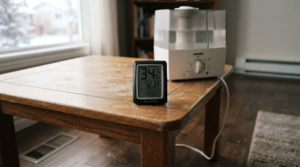
Buy a $15 hygrometer from any hardware store and put it on the main floor. If your reading sits under 30% once the furnace kicks in for winter, your wood is going to shrink and it’s going to show up as gaps.
What actually helps:
A whole-home humidifier tied into your furnace (the most effective fix and worth the install cost if you’re not already running one)
A portable humidifier in the room with the most hardwood, if a whole-home unit isn’t in the budget this year
Keeping houseplants, which do a little work but won’t get you all the way there on their own
Cracking a window for 10 minutes a day when it’s not brutally cold, believe it or not this helps refresh stale dry air
Don’t overcorrect either. Pushing humidity above 55% in winter risks condensation on your windows and, eventually, cupping in the opposite direction. Aim for the middle of that 35-55% range and you’re in good shape.
A mistake I see a lot: homeowners buy a humidifier, run it for two weeks in November, then forget about it once they get used to the dry air again. Humidity control only works if it’s consistent through the whole season. One good week doesn’t undo three dry months and it definitely won’t stop gaps from opening back up.
Placement matters too. A portable humidifier sitting in a corner of a big open-concept living room isn’t doing much for the hardwood in your hallway or upstairs bedroom. If you’re only running one unit, put it centrally and consider a small hygrometer in more than one room if your home has distinct zones.
Step 2: Check and adjust your thermostat habits
A lot of people crank the heat to 24°C and forget about it. That’s rough on wood.
Keep your home in the 18-21°C range if you can. Big temperature swings between rooms, especially near vents and cold exterior walls, create uneven drying that shows up as inconsistent gapping across the floor.
If you’ve got forced air heating pointed directly at a section of hardwood, consider a vent deflector. It’s a $10 fix that redirects hot, dry air away from the boards instead of blasting them all winter.
Step 3: Deal with entryways before the snow starts
Calgary winters mean salt, slush and grit tracked in on every boot. That combination is brutal on the finish.
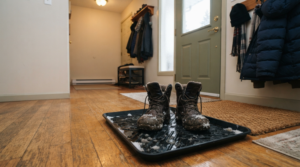
Put a real boot tray or mat right at the door, before the first snowfall, not after
Wipe up melted snow and salt residue the same day, don’t let it sit
Consider a walk-off mat that’s long enough for two full strides, most people underestimate how much they need
Salt crystals are abrasive. Left on a finished floor and ground in by foot traffic, they’ll dull and scratch the surface faster than almost anything else that happens to hardwood in a Calgary winter.
Step 4: Get ahead of refinishing, not behind it
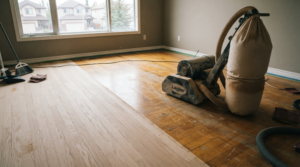
Late summer or early fall is genuinelythe best time to polish hardwood before winter arrives, mostly because the humidity is more stable for the finish to cure properly and because a fresh finish gives you a stronger moisture barrier heading into the dry months.
If your current finish is worn thin in walkways, water and grit can reach bare wood faster once winter starts. A worn finish plus dry winter air plus salt is a bad combination for your boards.
We usually recommenddustless hardwood floor refinishing for Calgary homeowners who want the work done without shutting down the house for a week, since it keeps the mess contained and the floor usable again much sooner.
If you’re deciding between finish types for durability against winter grit, our breakdown onoil vs water-based floor finish covers which holds up better under heavy winter traffic and which is easier to spot-repair later.
Waiting until January to book refinishing is the wrong move and not just because of scheduling. Cold, dry winter air makes finish cure slower and less evenly in some cases and you’re stuck living around the smell and downtime during the months you’re home the most. Booking yourhardwood floor refinishing in September or early October means the work is done and cured before the temperature drops and your floor goes into winter with a fresh protective layer instead of a worn one.
How installation type affects winter performance
Not every hardwood floor moves the same way, even within the same house. How it was installed matters as much as what it’s made of.
Nail-down floors have a bit more natural give across the whole surface, which can actually help distribute seasonal movement more evenly. Glue-down floors are more rigid and tend to show movement in more concentrated spots, usually where there’s the least adhesive coverage or where the subfloor itself has a weak point. Floating floors, common with a lot of engineered products, handle humidity swings differently again because the whole floor can expand and contract as one unit rather than board by board.
If you’re not sure which installation method your home has, it’s usually visible from a basement or crawl space, look at the underside, or your original installer’s paperwork will say. It’s worth knowing before winter, because the repair approach for a squeak or a gap is different depending on how the floor was put down in the first place.
For newer installs or renovations, the right installation method depends heavily on your subfloor type, whether that’s a concrete slab in a newer build or the older wood subfloors common in some of southwest Calgary’s established neighbourhoods.
Step 5: Protect furniture and high-traffic zones
Winter means more time indoors, more foot traffic and heavier furniture staying put in the same spot for months. That combination leaves marks if you’re not careful.
Felt pads under every chair and table leg, replaced when they wear thin
Area rugs in high-traffic paths, especially hallways and in front of the couch
Rotate rugs occasionally so you’re not creating a permanent sun-fade or wear line underneath one spot
None of this stops seasonal wood movement. It just keeps your finish from taking unnecessary damage while the movement happens.
Solid vs engineered: does it matter for winter prep?
It does, actually. If you’re building or renovating and haven’t picked your flooring yet,solid vs engineered hardwood in Calgary is worth reading before you commit.
Engineered hardwood’s layered construction resists the kind of shrinking and gapping that solid wood is more prone to in a dry Calgary winter, particularly over concrete or in basements. Solid hardwood can absolutely handle our winters too and a lot of homeowners prefer it, it just needs more consistent humidity management to stay stable.
Wood species matters here too. Somehardwood flooring species handle humidity swings better than others. Oak, for example, tends to be more forgiving of Calgary’s dry season than some of the softer or more exotic species.
A quick pre-winter checklist
Task
When to do it
Why it matters
Test indoor humidity
Early fall, before heating season
Establishes your baseline before it drops
Install or run a humidifier
Before first hard freeze
Keeps wood from shrinking too fast
Inspect finish for wear
Late summer
Catches problems before winter stress hits
Refinish if needed
September-October
Finish cures better in stable humidity
Set up entryway mats
Before first snowfall
Stops salt and grit from reaching the finish
Check thermostat habits
Ongoing through winter
Prevents uneven drying across rooms
What to do if water damage happens anyway
Even with good prep, accidents happen. A leaking boot, a spilled humidifier tank, a window that wasn’t sealed as well as you thought. If you catch standing water on hardwood, dry it immediately and don’t wait to see if it’s fine.
Left too long, moisture gets under the finish and into the wood itself and that’s a different repair entirely. Our guide onwater-damaged hardwood repair walks through what’s salvageable and what isn’t, depending on how long the water sat and which type of flooring you have.
What you can handle yourself vs when to call a pro
A lot of winter prep is genuinely DIY. Setting a hygrometer, running a humidifier, laying down entry mats, wiping up snow melt, adding felt pads under furniture, none of that requires a professional.
Where it makes sense to call someone:
Gaps that don’t close back up by early summer, which can point to a deeper humidity or subfloor issue
Cupping that’s gotten worse over more than one season
A finish that’s worn through to bare wood in walkways
Squeaking that’s gotten louder or spread to more of the floor
Any water damage bigger than a small spill you caught right away
Trying to sand and refinish a floor yourself without the right equipment usually ends up costing more in the long run, either because the sanding wasn’t even or because a rushed job traps moisture under a new finish right before winter, which is close to the worst timing possible for that mistake.
A note on older Calgary homes
If you’re in one of Calgary’s older communities, homes built in the 60s, 70s, or 80s often have original hardwood that’s outlasted several generations of homeowners already. That says a lot about the wood itself, but it also means these floors have usually been through decades of uneven humidity control before anyone thought to manage it properly.
If that’s your situation, don’t assume the floor is too far gone just because it’s got more visible seasonal movement than a newer install. Solid hardwood can be sanded and refinished multiple times over its life and older growth wood used decades ago is often denser and more stable than a lot of what’s sold today. A proper inspection will tell you whether you’re dealing with cosmetic wear or something structural.
The bottom line
You don’t need to overhaul your whole house to get through another Calgary winter with your floors intact. A hygrometer, a humidifier, decent entryway mats and catching finish wear before it gets bad will cover most of it.
If your floors are already showing gaps that don’t close, cupping near the windows, or a finish that’s worn through in the hallway, don’t wait for spring to deal with it.Contact Arbutus Hardwood for a straight assessment and a quote. We’ve been doing this in Calgary for over 30 years and we know exactly how this climate treats a hardwood floor.
Start with a hygrometer reading in your first week of cold weather. If you don't know the floor's refinishing history, get an inspection before winter stresses it further. New-to-you floors sometimes have hidden wear that only shows up once the dry season hits.
Wood loses moisture to dry indoor air and physically shrinks. The boards pull slightly apart from each other. It's normal seasonal movement and most gaps close back up on their own by summer.
Yes, in almost every case. Calgary's winter air is dry enough that most homes need active humidity management to keep hardwood stable, whether that's a whole-home unit or a portable one in the main living space.
Between 35% and 55% relative humidity, according to NWFA guidelines. Below that range for extended periods is when you start seeing excessive shrinkage and gapping.
Occasional seasonal shrinkage isn't permanent damage. Chronic exposure to very low humidity over years can cause deeper cracking, finish failure and boards that no longer close their gaps in summer. That's when you're looking at repair or refinishing rather than just seasonal movement.
It depends on traffic and finish type, but most Calgary homes need a refinish every 7 to 10 years. Homes with pets, kids, or high foot traffic sometimes need it sooner, especially if winter salt and grit have been wearing down the finish faster than expected.
How to choose a hardwood flooring contractor in Calgary Learn how to choose a hardwood flooring contractor in Calgary by checking experience, insurance, past projects and written quotes before you hire. Contact Us Your floors will be under your feet for 20 years or more. The person you hire to…
Hardwood Flooring Cost in Calgary: What You’ll Actually Pay Planning your project but unsure about hardwood flooring cost in Calgary? This guide explains installation, refinishing, and repair expenses to help you plan your flooring budget. Contact Us If you’re planning to install, repair, or refinish hardwood flooring in Calgary, understanding…
Matte vs gloss hardwood flooring: which finish is right for your home? Matte vs gloss hardwood flooring, see which finish suits Calgary homes best for durability, style & upkeep. Get expert advice from Arbutus Hardwood. Contact Us Matte vs gloss hardwood flooring feels like a small decision until you’re standing…