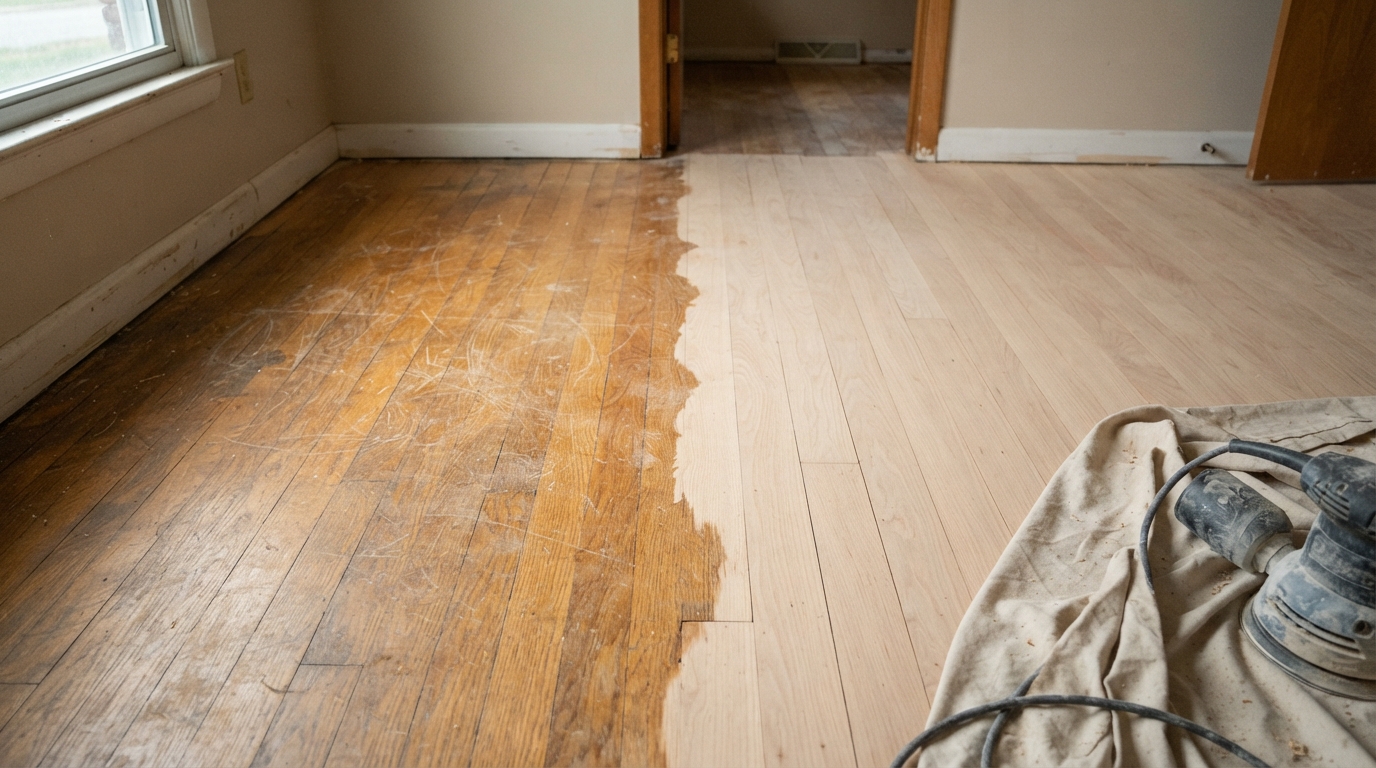

Your floors will be under your feet for 20 years or more. The person you hire to install or refinish them matters more than the wood species you pick.
If you’re working out how to choose a hardwood flooring contractor in Calgary, you’re asking the right question. Dry winters, chinook swings and a mix of old and new homes punish sloppy work. A bad job shows up as gaps by February and cupped boards by July.
Here’s what we’d check before you sign anything. You’ll get a vetting checklist, a quote comparison table, red flags and six FAQs. Use it for a full install or a refinish on floors you already own.
Why the contractor matters more than the wood
Hand the same pallet of white oak to two crews. One acclimates the boards, checks the subfloor moisture and leaves proper expansion gaps. The other opens the boxes and starts nailing. Same wood. Completely different floor in 3 years.
Hardwood is a natural material that moves with humidity. Calgary’s indoor air in winter can drop below 20% relative humidity, while most wood flooring guidelines call for 30% to 50%. That gap is where shrinking, cracking and cupping come from.
A good contractor plans for it. A weak one finds out after you’ve paid.
Most of the horror stories we hear fit a short list. If you want a sense of how many ways an install can go wrong, our breakdown of 9 hardwood installation mistakes that wreck Calgary floors is a useful read before you start calling people.
Start with the job you actually have
Contractors specialize. Some live for new-build installs. Others do mostly sanding and refinishing. A few handle custom patterns and borders. Knowing which job you have helps you ask sharper questions.
New installation
Installing hardwood means subfloor prep, moisture testing, acclimation and the right fastening method for your wood type. Solid planks are usually nailed down. Engineered boards can be glued or floated. Your contractor should explain why they picked one method for your house.
If you’re leaning toward engineered boards, which handle Calgary’s humidity swings better than solid in many cases, read our engineered hardwood installation guide for Calgary homeowners first. It covers the process and what to expect on the day.
Refinishing, repair and polishing
Floors that look tired aren’t always done for. A full sand and refinish removes the old coating and a thin layer of wood. A lighter hardwood floor polishing job can bring back the shine on floors that only have surface wear.
A contractor who pushes a full sand on every floor might be padding the invoice. One who recommends the lighter option when it fits is usually the one you want.
Repairs deserve a similar look. A few damaged boards, a water stain or a squeak don’t always call for a weekend project. We wrote up the real costs and risks in DIY vs professional hardwood floor repair.
Custom work
Borders, inlays, herringbone, wide planks, stairs and mixed-height transitions all need a different skill set. Ask to see finished examples of the exact thing you want. A crew that does custom hardwood flooring every month will have photos ready. A crew that has never done it will change the subject.
How to choose a hardwood flooring contractor in Calgary, step by step
Work through these 8 checks in order. Most bad contractors fail at step 2 or step 3.
1. Look for real Calgary experience
Experience in Calgary matters because the climate is rough on wood. Ask how long they’ve worked here and how they handle winter humidity. A good answer mentions acclimation time, moisture readings and expansion gaps. A weak answer is “we’ve never had a problem.”
Years in business count too. A company that has run for 30 years has survived plenty of bad winters and plenty of picky customers. Arbutus Hardwood, for example, has been working on Calgary floors for over 30 years and has completed more than 500 projects. Numbers like those are worth asking any contractor for.
2. Verify insurance and WCB coverage
This is the check most homeowners skip. It’s also the one that can cost you the most.
Ask for proof of liability insurance. Then ask for WCB coverage. In Alberta, if you hire a contractor who has no WCB account and a worker gets hurt in your house, you may be on the hook. The Workers’ Compensation Board explains when you need a WCB clearance letter before hiring and before releasing payment.
A real company will hand over both documents within a day. If you get excuses, move on.
3. Look at finished projects
Photos are good. Visiting a finished floor is better. Ask for 2 or 3 recent jobs similar to yours and look at them closely.
Check these things:
- Gaps between boards and along the walls
- Sanding swirl marks in raking light
- Finish bubbles, dust nibs or roller lines
- How cleanly the floor meets doorways, vents and stairs
- Whether the stain colour is even across the room
If the contractor has a gallery, scan it for variety. Our own gallery shows installs, refinishes, stairs and borders, so you can see the range before you call.
4. Read reviews the smart way
The details inside a review tell you more than the star count.
Look for reviews that mention timelines, communication and surprises. “Showed up on time and the quote matched the invoice” is worth more than “great job!!!” Read the 3-star reviews too, because they show how a company handles problems.
Builders and other trades are your best source. A Red Seal carpenter who keeps hiring the same flooring crew for years has already done your vetting for you.
Two examples from our own reviews show what to look for. One Calgary homeowner needed a white oak main floor finished before a firm move-in date. He praised the straight answers about timing and a final invoice that matched the quote. A contractor who works as a Red Seal carpenter wrote that we blended hardwood sitting at two different heights into one smooth floor. Specific stories like those are hard to fake.
5. Ask how they handle dust and mess
Sanding used to mean dust on every shelf for a week. Modern dustless systems with vacuum attachments cut that down a lot. Ask what equipment the contractor runs and how they protect furniture, vents and doorways.
Brands matter a little here. Contractors who work with established finish and sanding suppliers tend to be more serious about their process. Ask what finishes they use and why. If you’re torn between looks, our guide to high-gloss vs satin hardwood finish explains how each one wears.
6. Ask where the wood comes from

Some contractors only install what you buy. Others source and supply the material too. Both models work, but you should know which one you’re getting.
When one company handles both, there’s one party responsible if boards arrive warped or the colour is off. If you’re buying wood yourself, expect to coordinate delivery and acclimation. A contractor with a hardwood flooring supply service can often match species, grade and plank width to your subfloor and your budget without the back and forth.
7. Get 3 written quotes
Three is the sweet spot. Fewer than that and you can’t spot an outlier. More than that and you’ll drown in numbers.
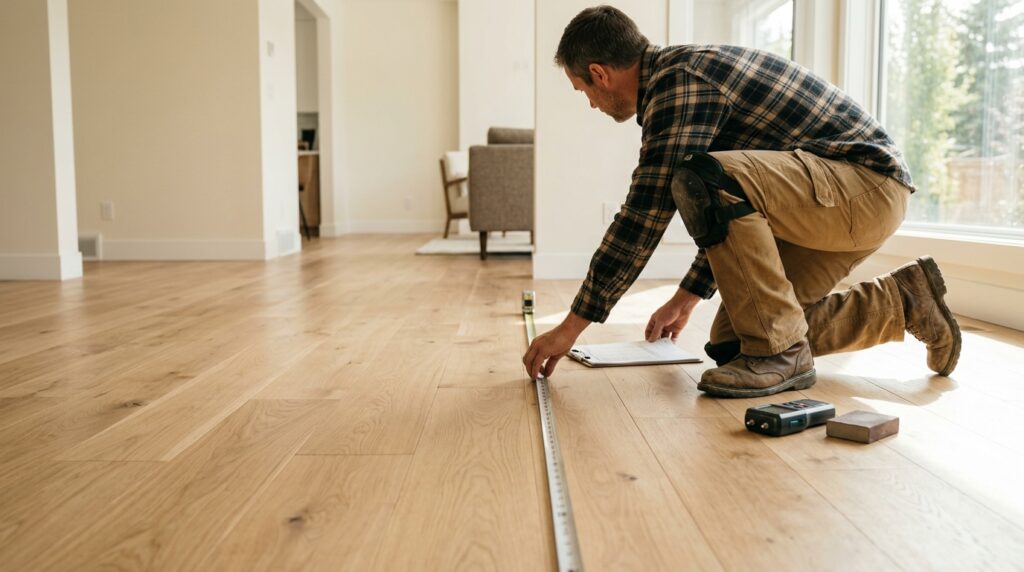
A written quote should name the wood species and grade, the square footage, the prep work, the finish system and the number of coats. It should also state what happens with baseboards, transitions and stair nosings. Verbal quotes are worth the paper they’re not written on.
8. Pin down the timeline, deposit and warranty
Ask for a start date and an end date. Ask what happens if the job runs over.
Weather and drying time can move a schedule, so a few days of cushion is reasonable. A contractor who promises a fixed date with no wiggle room on a site-finished floor is guessing. One who explains each stage and keeps you updated is planning.
Deposits are normal. A big chunk up front before any materials are ordered is a warning sign. Payment should follow progress. Get the workmanship warranty in writing, including what it covers and for how long.
What a good quote looks like
Compare quotes line by line. The cheapest number often leaves things out. The gaps show up later as change orders.
| Quote item | Strong quote | Weak quote |
|---|---|---|
| Wood details | Species, grade, width, thickness | “Hardwood flooring” |
| Square footage | Measured and listed | Rough estimate |
| Subfloor prep | Moisture test and levelling described | Not mentioned |
| Finish | Brand, type and number of coats | “Standard finish” |
| Extras | Baseboards, stairs, transitions itemized | Added later |
| Clean-up and disposal | Included and described | Unclear |
| Insurance and WCB | Proof offered | “We’re covered” |
| Warranty | In writing with terms | Verbal promise |
| Payment schedule | Tied to progress | Large deposit up front |
If two quotes differ by 30%, find out which line items explain the gap before you pick the lower one.
8 questions to ask on the first call
You can learn a lot in 10 minutes. Ask these:
- How many hardwood jobs like mine have you done in Calgary this year?
- How do you check subfloor moisture before installing?
- How long do you let the wood acclimate?
- Who actually does the work, your crew or subcontractors?
- What finish do you recommend for my household and why?
- How do you control dust during sanding?
- Can I see insurance and WCB documents?
- What does your warranty cover and for how long?
Listen to how they answer. Confident, specific answers beat polished sales pitches every time. If they get defensive about the questions, that tells you how they’ll handle problems on site.
Red flags and green flags
You’ll spot most trouble before the job starts.
| Red flags | Green flags |
|---|---|
| Quote arrives without a site visit | Measures your space in person |
| Pressure to sign today | Gives you time to compare |
| Cash-only or big upfront payment | Clear payment schedule |
| No insurance or WCB proof | Documents provided quickly |
| Vague about materials | Names species, grade and finish |
| No recent local projects | Shows finished Calgary homes |
| Promises a 2-day install on a whole house | Gives a realistic timeline |
| Dodges questions about humidity | Talks about acclimation and moisture |
One red flag can be a bad day. Three of them is a pattern.
Mistakes homeowners make when hiring
We see the same errors over and over.
Hiring on price alone. A quote 25% lower usually skips something. Prep work, finish coats and proper clean-up are the usual casualties.
Skipping the site visit. Nobody can quote a floor accurately from a phone call. Subfloor type, existing coatings and room layout all change the job.
Ignoring the season. Winter installs need extra attention to indoor humidity. Summer jobs have their own issues when the house is sticky. A good contractor will tell you how to prepare your home. If you’re planning a refinish, timing matters too. The best time to polish hardwood floors in Calgary depends on the season and your schedule.
Forgetting about furniture and pets. Moving a full living room takes planning. Ask who does it and where things will sit during the job.
Not reading the warranty. Some warranties cover almost nothing. Others exclude humidity damage, which is the most common problem in Calgary. Read before you sign.
What drives the price
Price per square foot never tells the full story. These factors move the total:
- Wood species and grade. Maple and white oak sit in a different range than walnut or exotic species
- Solid vs engineered construction
- Subfloor condition, including levelling and moisture work
- Stairs, which take far more labour than flat floor
- Pattern choice. Herringbone and borders take more time than straight lay
- Finish system and number of coats
- Removal of old flooring
- Furniture moving and clean-up
Ask each contractor to break the price into labour, materials and extras. When two numbers differ, you’ll see exactly why.
Special situations in Calgary
Condos. Many boards require underlay that meets sound ratings. Get the building’s flooring rules in writing before you order anything. Your contractor should know how to handle this.
Basements. Concrete holds moisture. Solid hardwood usually doesn’t belong down there. Engineered products need moisture testing first.
Homes with in-floor heating. Wood species, plank width and installation method all matter. Check with your contractor and your flooring manufacturer.
Homes outside city limits. If you’re in Airdrie, Cochrane, Okotoks or Chestermere, ask whether the contractor covers your area without extra travel fees. Arbutus Hardwood, for instance, serves Calgary and nearby communities including Airdrie, Cochrane, Okotoks and Chestermere.
Older homes. Existing floors may have decades of finish or uneven boards. A seasoned crew will assess whether sanding, repair or replacement makes sense.
Final thoughts
Knowing how to choose a hardwood flooring contractor in Calgary comes down to a few habits. Verify insurance and WCB. Look at finished work. Get 3 written quotes and compare them line by line. Ask about humidity and acclimation until you hear specific answers.
Then trust your gut on communication. A contractor who returns calls, shows up on time and answers questions plainly will usually do the same on the job.
If you’re ready to talk, Arbutus Hardwood has spent over 30 years working on Calgary floors. Contact us for a free quote or call 403-371-7531. You can also visit the Arbutus Hardwood homepage to see our services and recent work.

How to choose a hardwood flooring contractor in Calgary
How to choose a hardwood flooring contractor in Calgary Learn how to choose a hardwood flooring contractor in Calgary by checking experience, insurance, past projects and written quotes before you hire. Contact Us Your floors will be under your feet for 20 years or more. The person you hire to…

Hardwood Flooring Cost Calgary: 2026 Price & Installation Guide
Hardwood Flooring Cost in Calgary: What You’ll Actually Pay Planning your project but unsure about hardwood flooring cost in Calgary? This guide explains installation, refinishing, and repair expenses to help you plan your flooring budget. Contact Us If you’re planning to install, repair, or refinish hardwood flooring in Calgary, understanding…

Matte vs Gloss Hardwood Flooring | Arbutus Hardwood
Matte vs gloss hardwood flooring: which finish is right for your home? Matte vs gloss hardwood flooring, see which finish suits Calgary homes best for durability, style & upkeep. Get expert advice from Arbutus Hardwood. Contact Us Matte vs gloss hardwood flooring feels like a small decision until you’re standing…